

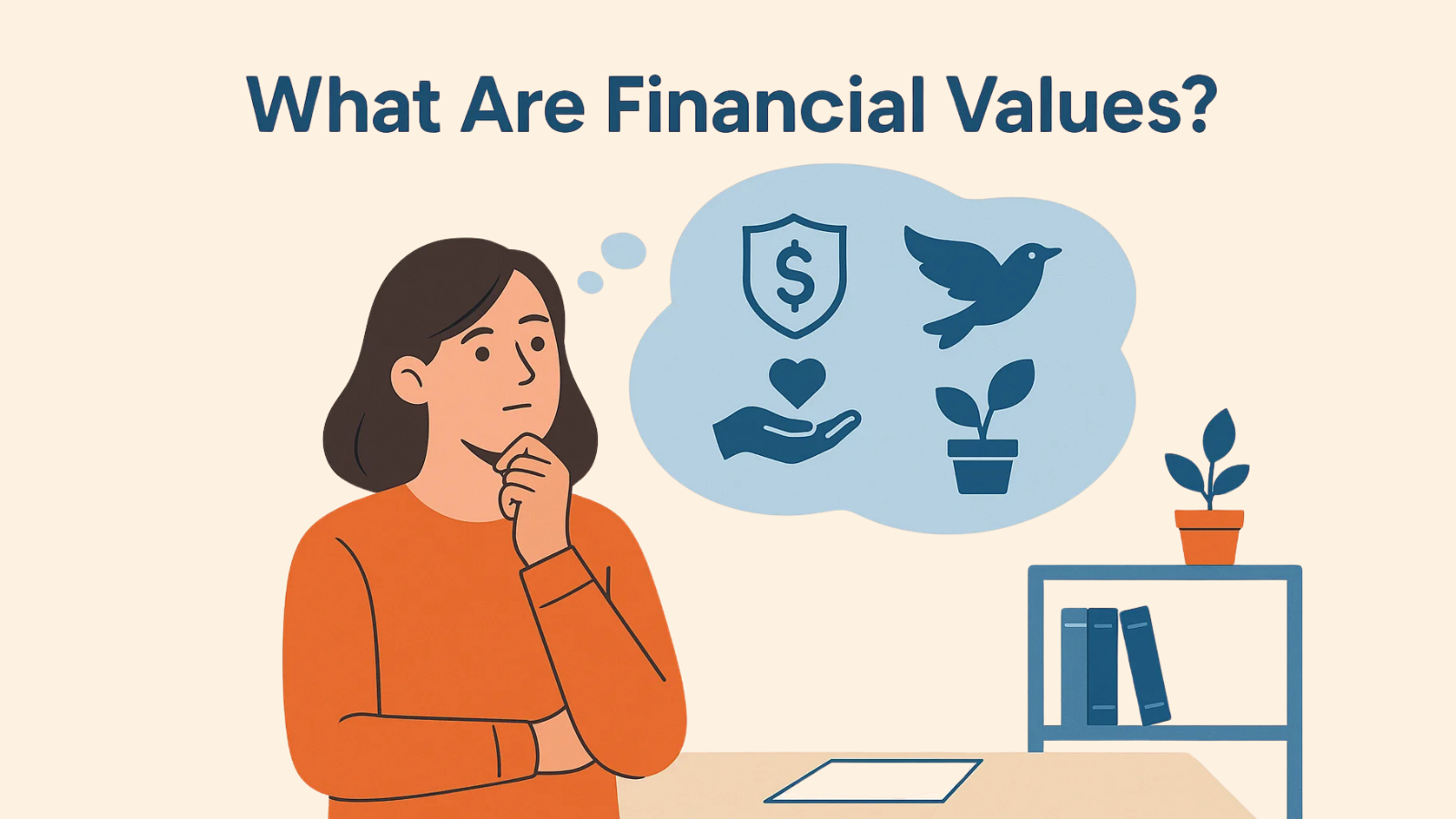
Ever felt like you’re doing everything right with your money saving, budgeting, working hard, yet still feel anxious or oddly unsatisfied? You’re not alone. Many of us follow tips and tools but overlook the deeper driver of every money choice: our financial values. When your spending, saving, and earning reflect your core beliefs, stress drops and clarity rises.
This article explains what are financial values, why they matter for mental health and financial wellness, and how to define and apply them without jargon or guilt. Whether you’re just starting your wealth-building journey or working toward major goals like saving for a house, understanding your financial values is the foundation that makes everything else click.
What Financial Values Really Mean (and How They Differ from Goals)
Financial values are the principles and beliefs that guide how you earn, spend, save, invest, and give. They are the why behind your choices. Financial goals, by contrast, are the measurable what the targets you set for a specific time frame. Values inform goals, not the other way around.
Here’s the thing: you can chase a savings target for months and hit it, but if it doesn’t align with what you actually value, the achievement feels hollow. That’s the difference between doing what you think you should do and doing what genuinely matters to you.
Here’s a quick comparison to keep the difference crystal clear:
| Financial Goals | Financial Values |
| Save $10,000 this year | Prioritize long-term security and planning |
| Pay off credit-card debt in 12 months | Commit to financial freedom and responsibility |
| Travel twice a year | Value experiences over possessions |
| Start investing 10% of income | Build a future and create stability |
| Donate 5% to charity | Practice generosity and community care |
Think of values as your money philosophy the compass you carry into every decision. Goals are the mile markers on the road. Goals can change as life shifts; your core money values remain steady and help you recalibrate when circumstances throw you off course.
Why Financial Values Matter for Mental & Financial Health
Money is emotional. When actions and beliefs are misaligned, friction shows up as second-guessing, guilt, or impulse spending. When they match, you feel lighter and more confident.
Research from the University of South Australia shows that financial stress significantly impacts mental health, affecting sleep, relationships, and overall wellbeing. But here’s what’s interesting: it’s not always the amount of money that matters most it’s whether your money decisions feel authentic to who you are.
The American Psychological Association has documented that money remains one of the top stressors for adults across all income levels. The common thread? Disconnect between what people value and how they actually use their resources.
In practice, aligning your personal finance values delivers four big benefits:
- Less guilt, more calm. Spending feels intentional rather than reactive. You’re not second-guessing every purchase or scrolling through bank statements with dread.
- Clear priorities. You know what to fund first and what to delay. Decision fatigue drops dramatically when you have a values filter.
- Resilience under pressure. During uncertainty, values act like rails that keep you steady. When unexpected expenses hit, you’re not scrambling you’re referring back to what matters most.
- Motivation that lasts. Goals tied to genuine financial principles are easier to stick with. You’re not relying on willpower; you’re following a path that feels right.
For trustworthy, practical guidance while you build skills around this mindset, bookmark the Consumer Financial Protection Bureau. They offer free resources on everything from budgeting to debt management, all grounded in helping people make informed decisions.
Examples of Strong Financial Values
Use these examples of financial values as inspiration. Choose the few that genuinely resonate quality over quantity. You don’t need to adopt all of them; in fact, trying to honor too many values at once usually dilutes your focus.
1. Security
Build buffers (emergency fund, insurance) so surprises don’t derail you. Security-driven people prioritize having six months of expenses saved before taking financial risks.
2. Financial Freedom
Keep debt low and cash flow flexible to protect options. This value often shows up as refusing credit card debt or maintaining multiple income streams.
3. Generosity
Give money, time, or expertise to people and causes you value. Generous people find meaning in impact, not accumulation.
4. Simplicity
Prefer fewer, better things; cut financial clutter and fees. Simplicity means one checking account instead of five, owning quality items that last, and avoiding complicated investment schemes.
5. Growth
Invest in learning, health, and tools that expand your earning power. Growth-oriented people see courses, coaching, and skill-building as non-negotiable expenses.
6. Integrity
Make honest, transparent choices; avoid schemes that conflict with your ethics. This might mean refusing commissions on products you don’t believe in or rejecting “get rich quick” offers.
7. Balance
Enjoy life now while preparing for later; avoid all-or-nothing thinking. Balance seekers refuse to sacrifice today’s happiness for tomorrow’s security or vice versa.
8. Sustainability
Spend in ways that support people and the planet. This value shows up in everyday choices like shopping local, choosing ethical brands, or investing in green funds.
9. Stewardship
Manage resources carefully; leave things better than you found them. Stewards think multi-generationally, asking What legacy am I creating?
10. Legacy
Build assets and knowledge that support future generations. Legacy-minded people create trusts, write wills early, and teach their children about money openly.
Snippet-friendly definition
Financial values are the guiding principles like security, freedom, and generosity that shape your money decisions every day.
Notice how different these feel? Someone who values freedom might happily live on less to avoid a demanding job. Someone who values security might do the opposite. Neither is wrong they’re just different expressions of what financial values mean to each person.
How to Identify Your Own Financial Values (5-Step Exercise)
You don’t need a spreadsheet to define financial values you need reflection. Try this simple process. Set aside 30 minutes, grab a notebook, and work through these steps without judgment.
1) Reflect on peak moments
Think of three money decisions that made you proud or peaceful. Maybe it was saying no to a purchase that didn’t fit, helping a friend in need, or finally funding that trip you’d been dreaming about. What values were present security, generosity, independence, curiosity? Name them.
2) Review recent spending
Scan the last 60-90 days of bank statements. Which purchases felt aligned with your priorities? Which felt like autopilot or pressure? Circle the aligned ones; they reveal your values and your current money mindset. Be honest here. That impulse buy you regret? It’s data. The subscription you forgot about? Also data. You’re not judging you’re investigating.
3) Translate feelings into value words
Convert patterns into 3-5 value labels (e.g., security, freedom, learning, family, service). Write one sentence for each that describes what it means to you. Make it personal, not generic.
Instead of “I value security, try Security to me means having enough saved that I can take a career risk without panic.
4) Rank and reality-check
Order your values by importance. Ask, Where does my time and money already reflect this? Where is there friction? The gap shows where to focus. If you say family is your top value but you’re working 70-hour weeks and never see your kids, there’s a disconnect worth exploring. No shame just awareness.
5) Commit to one small behaviour per value
Turn each value into a habit you can do this week. Small actions create momentum and reduce decision fatigue.
- Value security? Automate $50 to savings.
- Value growth? Buy that course you’ve been eyeing.
- Value simplicity? Cancel one unused subscription.
Start small. Consistency beats intensity every time.
How to Apply Financial Values Daily (Micro-Habits)
Knowing your values is powerful; living them is transformational. Use these micro-habits to practice value-based budgeting and mindful spending without perfectionism.
1. Name your top three values on your budget
Create three flexible “value buckets (e.g., Security, Learning, Experiences) and fund them first. Instead of the typical categories like “groceries” and “utilities,” your budget leads with what matters most.
This doesn’t mean you skip essentials it means you frame your budget as a values document first, expenses second.
2. Adopt a 24-hour pause for non-essentials
Impulses fade; values stay. If it still fits after a day, buy it with confidence. This one habit alone can cut unplanned spending by 30-40%, simply by creating space between want and action.
3. Use a one-sentence rule at checkout
Say, I’m buying this because it supports (value). If you can’t fill the blank, skip it. It sounds simple, but this filter is remarkably effective.
I’m buying this coffee maker because it supports my value of simplicity I will stop spending $5 daily at the café. Clear? Buy it.
4. Automate what aligns
Transfers to savings, investments, or giving accounts should happen without willpower. Automation expresses your financial principles consistently, even on days when motivation is low.
If you value generosity, set up automatic monthly donations. If you value security, automate emergency fund contributions. Make your values the default, not the exception.
5. Schedule a monthly values review
In a 20-minute session tea, calm playlist open your statements and ask: What aligned? What didn’t? What will I adjust?
This isn’t about beating yourself up over mistakes. It’s about staying connected to your why. Young professionals who adopt this habit report feeling more in control of their finances and less reactive to money stress.
6. Optimize one bill each month
Call a provider, cancel a fee, negotiate a rate. Put the savings into your top value bucket. This habit does double duty: it cuts waste and funds what matters.
Even $20 saved per month adds up to $240 annually money that can go toward values instead of corporate profits.
7. Share your values with your partner or family
A five-minute check-in prevents resentments and keeps goals anchored in shared core money values. Money fights usually aren’t about money they’re about mismatched values that were never discussed.
Say, I realized I value security more than I thought. Can we talk about how that shows up in our budget? Vulnerability beats blame every time.
These habits shift your identity from budget enforcer to values-based steward, which is far more sustainable. You’re not restricting yourself you’re directing yourself toward what you genuinely care about.
Common Mistakes When Defining Financial Values (and How to Avoid Them)
Even with good intentions, people stumble when they define financial values. Here’s what to watch for.
Choosing values that sound good instead of feel true.
Everyone says I should value investing, so I guess I do. If it doesn’t light you up, it’s not your value it’s someone else’s.
Picking too many values.
More than five usually means you’re diluting focus. Narrow down to the 3-4 that genuinely drive your decisions.
Setting values but never reviewing behaviour.
Values without action are just wishes. Check in monthly. Are you living them?
Ignoring emotional spending patterns.
If you say you value security but splurge when stressed, your real value might be comfort or control. Be honest about what actually drives you, not what you think should.
Treating values as permanent.
Life changes. Your 25-year-old self might value adventure; your 45-year-old self might value stability. Revisit your values yearly and adjust as needed.
How Financial Values Connect to Bigger Goals
Understanding what are financial values isn’t just philosophical it’s practical. When you’re clear on your values, setting and achieving goals becomes exponentially easier.
Let’s say you’re saving for a house. If you value security, you’ll prioritize a larger down payment to reduce monthly stress. If you value freedom, you might buy a smaller home to keep mortgage payments low and maintain flexibility. Both approaches work but only if they match your actual values.
Same goal, different execution, because the financial principles underneath are different. That’s why cookie-cutter advice fails so often. It doesn’t account for the values driving the person.
When you’re building wealth, advancing in your career, or making any significant financial move, your values act as a north star. They help you say no to opportunities that don’t fit and yes to the ones that do even when the “right” answer isn’t obvious.
FAQs: Quick Answers People Also Ask
What are financial values, in simple words?
They’re the principles that guide how you use money your consistent why for spending, saving, earning, and giving. Think of them as your money rulebook, written by you, for you.
Are financial values the same as money beliefs?
Not exactly. Money beliefs are stories you hold (e.g., I’m bad with money). Financial values are chosen principles (e.g., I value learning, so I invest in courses”). Beliefs can be unhelpful; values are intentional.
What’s the difference between financial values and goals?
Values are enduring principles; goals are time-bound targets. Values steer; goals measure progress. A value might be “security. A goal might be “save $10,000 by December.
How do I find my financial values fast?
Reflect on proud money moments, review recent spending, pick 3-5 value words, and tie each to one small habit. You can finish a first draft in under an hour. The key is honesty, not speed.
What are examples of financial values?
Security, financial freedom, generosity, simplicity, growth, integrity, balance, sustainability, stewardship, and legacy. Choose the ones that resonate you don’t need to adopt them all.
Can financial values change over time?
Absolutely. What mattered in your twenties might shift in your forties. Revisit your values annually or after major life changes (marriage, kids, career shifts, health events).
How do personal finance values affect daily spending?
When you know your values, you stop asking “Can I afford this?” and start asking. Does this align with what I value? It’s a filter that makes decisions faster and regret less common.
Conclusion: Calm, Confident Money Starts with Values
If you’ve ever wondered What are financial values and why do they matter so much? here’s the essence: values turn money from a source of stress into a source of stability. They help you ignore trends, choose intentionally, and build a life that fits.
Define your top values, connect them to one small behaviour each, and review monthly. Over time, your budget will stop feeling restrictive and start feeling like a mirror of what you care about mosttrue financial wellness.
Money decisions become simpler when you know your why. You’re not reacting to every ad, comparison, or external pressure. You’re responding to your own priorities, consistently and calmly.
Ready to get started? Grab a notebook and spend 30 minutes working through the 5-step exercise above. Write down your top three financial values and one micro-habit for each. That’s it no over whelms, no perfection required. Just clarity, one value at a time
Join the Conversation
Which of these 7 microhabits will you try first to align your money with your values?