

You sit down at your desk, open your laptop, and stare at your to-do list. You know exactly what needs doing. And yet somehow 90 minutes later you’ve reorganised your desktop icons, made a third cup of coffee, and replied to emails that could have waited until Thursday.
Sound familiar?
Here’s the truth: figuring out how to stop procrastinating at work isn’t a willpower problem. It’s about understanding why your brain keeps hitting the brakes and giving it a smarter system to work with.
Whether you’re drowning in deadlines or just struggling to start that one report you’ve been avoiding all week, this guide on how to stop procrastinating at work breaks it down practically and honestly.
Let’s get into it.
Why We Procrastinate at Work.
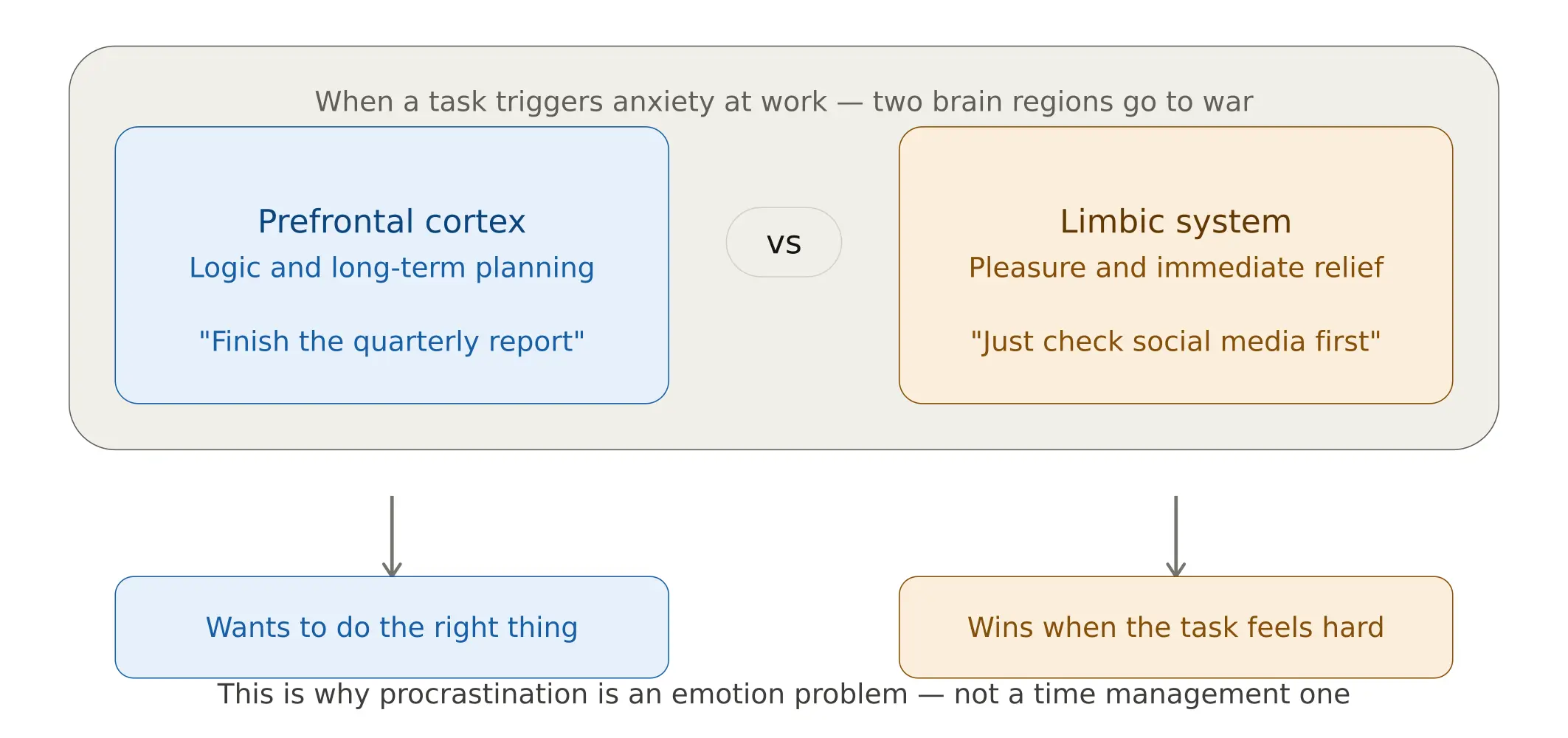
Here’s the catch: procrastination isn’t a time management problem it’s an emotion regulation problem. According to the American Psychological Association, your brain isn’t being lazy. It’s actively avoiding the discomfort, anxiety, or self-doubt that a certain task triggers.
And here’s the neuroscience behind it. Two parts of your brain are in constant conflict: the limbic system, your brain’s pleasure and reward centre, and the prefrontal cortex, the part responsible for logic, planning, and long-term thinking. When a task feels threatening or tedious, the limbic system wins. You reach for Instagram instead of finishing the presentation every time.
Once you understand that, everything changes. You stop blaming your character and start fixing the system.
Here are the three biggest culprits at work:
Task overwhelm.
Large, vague tasks feel impossible to start. When your brain can’t see a clear first step, it defaults to avoidance. Staring at a blank document is significantly harder than editing a messy first draft. The task itself isn’t the problem. The size and vagueness of how you’re holding it in your head is.
Fear of failure and perfectionism.
Perfectionism feels like high standards but it often functions as procrastination in disguise. If you never start, you can never fail. Your brain knows this. So it keeps finding reasons to delay until conditions are just right. Spoiler: they never are.
Low intrinsic motivation.
When a task has no clear connection to something you care about, your brain assigns it low priority even when your deadline strongly disagrees. The fix isn’t forcing enthusiasm. It’s connecting the task to a bigger outcome you actually value.
If unclear priorities are feeding your procrastination, it’s worth reading our guide on prioritising your tasks at work before diving into the strategies below.
How to Prioritize Tasks at Work, The Essential 3-Layer System for Professionals.
Procrastination vs Laziness: What’s Actually Different.
Let’s set the record straight: procrastination and laziness are not the same thing and confusing them is one of the main reasons people stay stuck.
Laziness implies a lack of willingness to exert effort. A procrastinator, however, desperately wants to finish the task but feels paralysed by the emotional weight of it. The mental activity is high. The anxiety is real. The avoidance is active, not passive.
Here’s the difference in plain terms:
Procrastination
Laziness
Intent
Emotion
Mental state
Outcome
Wants to complete the task.
High anxiety and guilt.
Active but avoidant.
Guilt, stress, and eventual action.
Disinclined to exert effort.
General indifference.
Low activity, lethargic.
Task remains undone.
Understanding this distinction matters because the solutions are different. Laziness needs motivation. Procrastination needs a smarter emotional strategy which is exactly what the ten techniques below provide.
The Real Cost of Workplace Procrastination.
Most people don’t realise how serious it is to stop procrastinating at work until the costs start stacking up. Workplace procrastination isn’t just an annoying habit it compounds over time in ways most people significantly underestimate.
The highest cost isn’t the missed deadline. It’s the mental load of carrying undone tasks. That constant background noise of “I really should have done that by now” is exhausting and it doesn’t switch off when you close your laptop.
The good news? Learning how to stop procrastinating at work doesn’t require a personality overhaul. Small, consistent changes break this cycle faster than you’d expect.
How to Stop Procrastinating at Work: 10 Ways to Fix It.
These aren’t abstract theories. Each strategy below targets a specific reason why procrastination happens and gives you something concrete to try today.
1. Break Every Task Into the Smallest Possible Step.
Your brain doesn’t resist work; it resists unclear, overwhelming work. The moment a task feels too big or vague, it gets filed under “later.”
The fix? Make the first step almost embarrassingly small.
Instead of “write the quarterly report,” try “open a blank doc and write the section headings.” That one tiny action breaks the inertia. And once you’re moving, staying in motion is far easier than starting from zero.
2. Use the 2-Minute Rule
If a task takes less than two minutes do it right now. Don’t list it. Don’t schedule it. Just do it.
Answering a quick email, filing a document, sending a one-line update these clog your mental bandwidth when left pending. Clearing them immediately builds momentum and keeps your to-do list from becoming a source of quiet dread.
But there’s more: this approach, popularised by James Clear in Atomic Habits, removes the decision cost from low-effort tasks entirely. Your cognitive load drops. Momentum builds. The next task feels easier before you’ve even started it.
3. Set a Timer, Not Just a Deadline.
Deadlines create pressure. Timers create focus. And if you’re serious about how to stop procrastinating at work, this difference matters more than you’d think.
Try the Pomodoro Technique work for 25 minutes on one task only, then take a 5-minute break. No multitasking, no tab-switching, no phone. Just 25 minutes.
The reason this works is psychological: finite feels manageable. When you tell your brain “just 25 minutes” instead of “work on this all afternoon,” resistance drops significantly. You’d be surprised how much you can produce in focused bursts versus scattered hours.
4. Identify Your Personal Procrastination Triggers.
Not all procrastination looks the same. Some people stall on tasks requiring deep thinking. Others avoid anything with social risk like sending a pitch or presenting an idea. Others go blank when a task lacks clear instructions.
Spend three days keeping a simple log: what task did I avoid? What was I feeling before I avoided it? What did I do instead?
Patterns emerge quickly. And once you know your specific triggers, you can design specific responses rather than just telling yourself to try harder.
5. Build Your Task List the Night Before.
Decision fatigue is a real and underrated cause of morning procrastination.
When you sit down without a clear plan, your first task becomes deciding what to do, and that friction is often enough to send you straight to your inbox or social feed.
Spend five minutes each evening writing your top three priorities for tomorrow. Not a 20-item list. Just three. When you sit down the next morning, the path of least resistance becomes the right one. Our guide on how to plan your day effectively gives you a complete daily framework that removes this friction permanently.
How to Plan Your Day Effectively: 7 Strategies That Change How You Work.
6. Reduce Friction Remove Distractions Before They Happen.
You don’t beat distraction through willpower. You beat it through design.
Willpower is a finite resource. If your phone is face-up on your desk, you will check it eventually. If social media tabs are one click away, you will wander.
Make distraction harder than work: put your phone in another room during deep work blocks, use a website blocker like Freedom or Cold Turkey, close every tab except the one you need, and tell people around you when you’re in a focus block.
Our guide on staying focused at work goes deeper on this, but even one of these changes makes a measurable difference immediately.
7. Build an Accountability System
Accountability is one of the most underused yet most effective tools against workplace procrastination.
Tell a colleague, friend, or accountability partner what you’re working on today and when you’ll have it done. That social commitment creates real psychological pressure not the paralysing kind, but the motivating kind.
No accountability partner? Send yourself a calendar block with the task in the title. Something about seeing “finish client proposal 2pm” on your calendar makes it feel more real than a sticky note ever will.
8. Tackle the Task You’re Dreading First
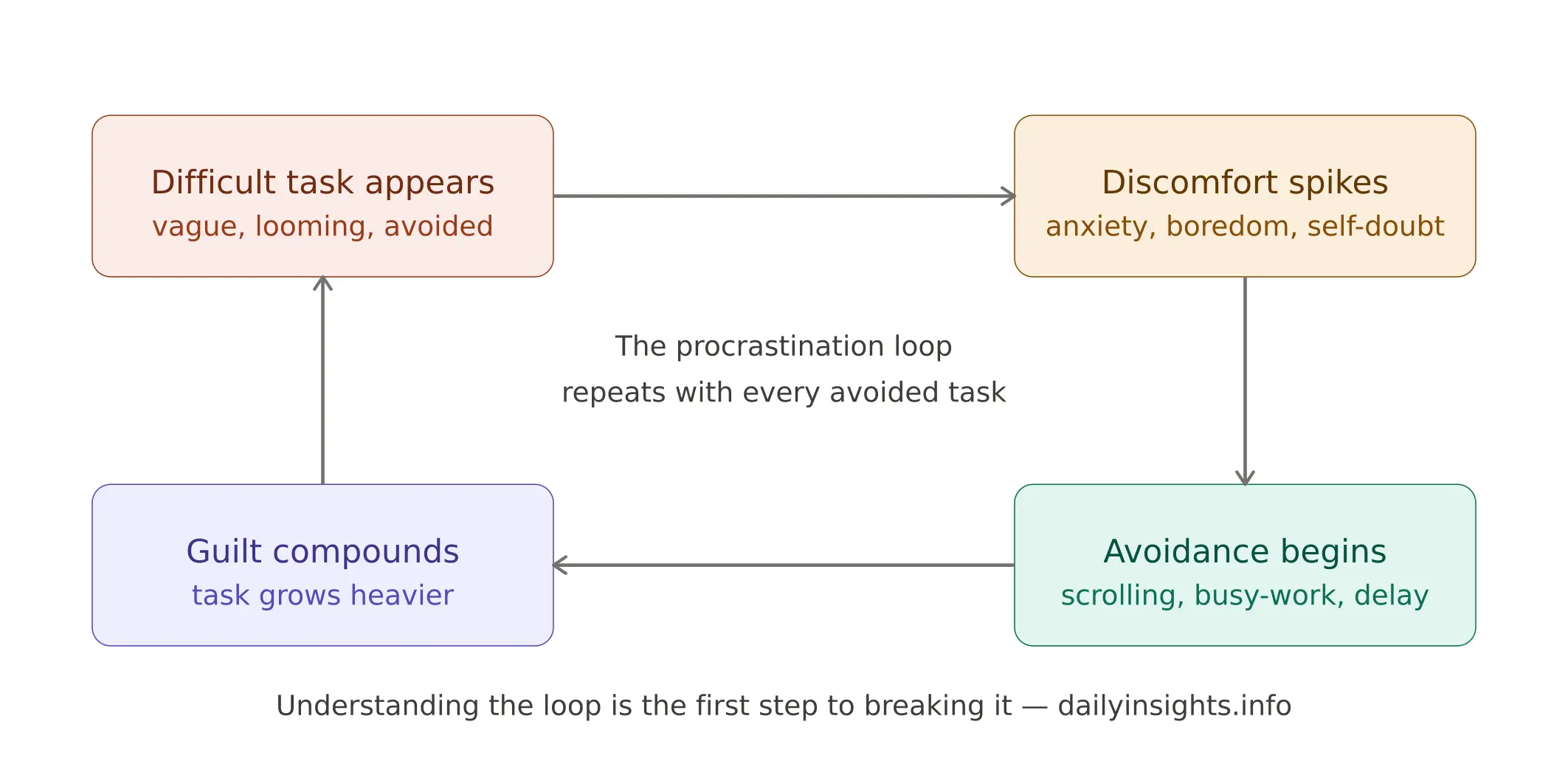
Most people procrastinate on their hardest, most anxiety-inducing task and spend the whole day doing easier things around it while that one task grows heavier by the hour.
Flip the script.
Do the dreaded task first ideally within the first 90 minutes of your workday when mental energy is highest. This approach, often called “eating the frog,” clears the psychological weight that’s been slowing everything else down.
Once the hardest thing is done, the rest of your day genuinely feels lighter. Try it once and you’ll understand why.
9. Celebrate Small Wins Deliberately.
Progress is motivating. But only if you notice it.
Most people finish a task and immediately move to the next without pausing to acknowledge what they’ve just done. Over time, work starts to feel like an endless treadmill which makes procrastination more appealing by comparison.
Make completions visible. Cross tasks off a physical list. Move a sticky note from “to-do” to “done.” Give yourself a genuine 30-second acknowledgement before moving on. These micro-moments of recognition reinforce the behaviour loop you’re trying to build.
10. Stop Beating Yourself Up Seriously.
Self-criticism after procrastinating makes the next episode more likely, not less.
When you spiral into guilt and self-judgment, you raise your emotional distress which is exactly the state that triggers procrastination in the first place. It becomes a cycle that feeds itself.
Research on self-compassion consistently shows that people who treat themselves kindly after setbacks are more likely to correct their behaviour not less. So when you catch yourself procrastinating, the most productive response is simple:
“I stalled. That’s okay. What’s the smallest next step I can take right now?” Then take it.
Working From Home? Here’s Why Procrastination Hits Harder.
If you work remotely, everything above still applies, but the environment adds extra layers worth addressing specifically.
Office environments have built-in accountability: colleagues around you, visible managers, social norms around being seen to work. At home, all of that disappears. Workplace procrastination finds much more room to breathe.
WFH trigger
Practical fix
No clear start signal.
Home distractions everywhere.
Blurred work/life boundaries.
No social accountability.
Everything equally accessible.
Create a “fake commute,” a 10-min walk before sitting down signals work has begun.
Set up a dedicated workspace, even one corner of one room; physical separation matters.
Set fixed start and finish times; treat them like external appointments.
Set up a virtual co-working session even a silent Zoom call creates presence.
Remove your phone from your workspace during focus blocks.
The key insight: at home, you can’t rely on your environment to do the structural work an office once did. You have to build that structure deliberately.
Common Questions About Stopping Procrastination at Work.
How do I get myself to work when I really don’t want to?
Knowing how to stop procrastinating at work starts with one rule: make the first action so small it feels ridiculous. Open the document. Write one sentence.
Why do I procrastinate even on tasks I actually care about?
Almost certainly: perfectionism. When something matters to you, the stakes feel higher which makes starting feel riskier. The fix is giving yourself explicit permission to do a bad first version. A rough draft exists to be improved. Nothing exists to be nothing. Done always beats perfect.
Is procrastination a mental health issue?
Chronic procrastination can be linked to anxiety, depression, ADHD, and perfectionism but occasional procrastination is a normal human experience. If it’s significantly affecting your work and quality of life consistently, speaking with a professional is a worthwhile step. For most people, the strategies in this guide address the root triggers effectively.
How is procrastination different from being lazy?
Laziness is a lack of willingness to exert effort. Procrastination is the opposite high emotional engagement with a task, paired with avoidance of it. Procrastinators want to complete the task but feel paralysed by anxiety, fear of failure, or overwhelm. The solution for each is completely different, which is why self-criticism rarely helps.
You Can Take Control of Your Workday Starting Today.
Workplace procrastination doesn’t define you. It’s a habit loop built over time and absolutely possible to disrupt.
Every productive person you admire still procrastinates sometimes. The difference isn’t more discipline or more motivation. It’s a system a set of small, reliable responses for when the resistance shows up.
Now you have one too.
Start with just one strategy. Not ten. One:
- Break your next big task into a single tiny first step right now
- Set a 25-minute timer before your next work session
- Write your top three priorities for tomorrow before you close your laptop tonight
That’s it. One step today becomes a system next week. And that system is how to stop procrastinating at work for good.
What’s the one task you’ve been putting off the longest? Drop it in the comments. Sometimes, just naming it out loud is the first step toward finally getting it done.
Want practical productivity strategies every week? Subscribe to the Daily Insights newsletter and get ideas like these delivered straight to your inbox.