

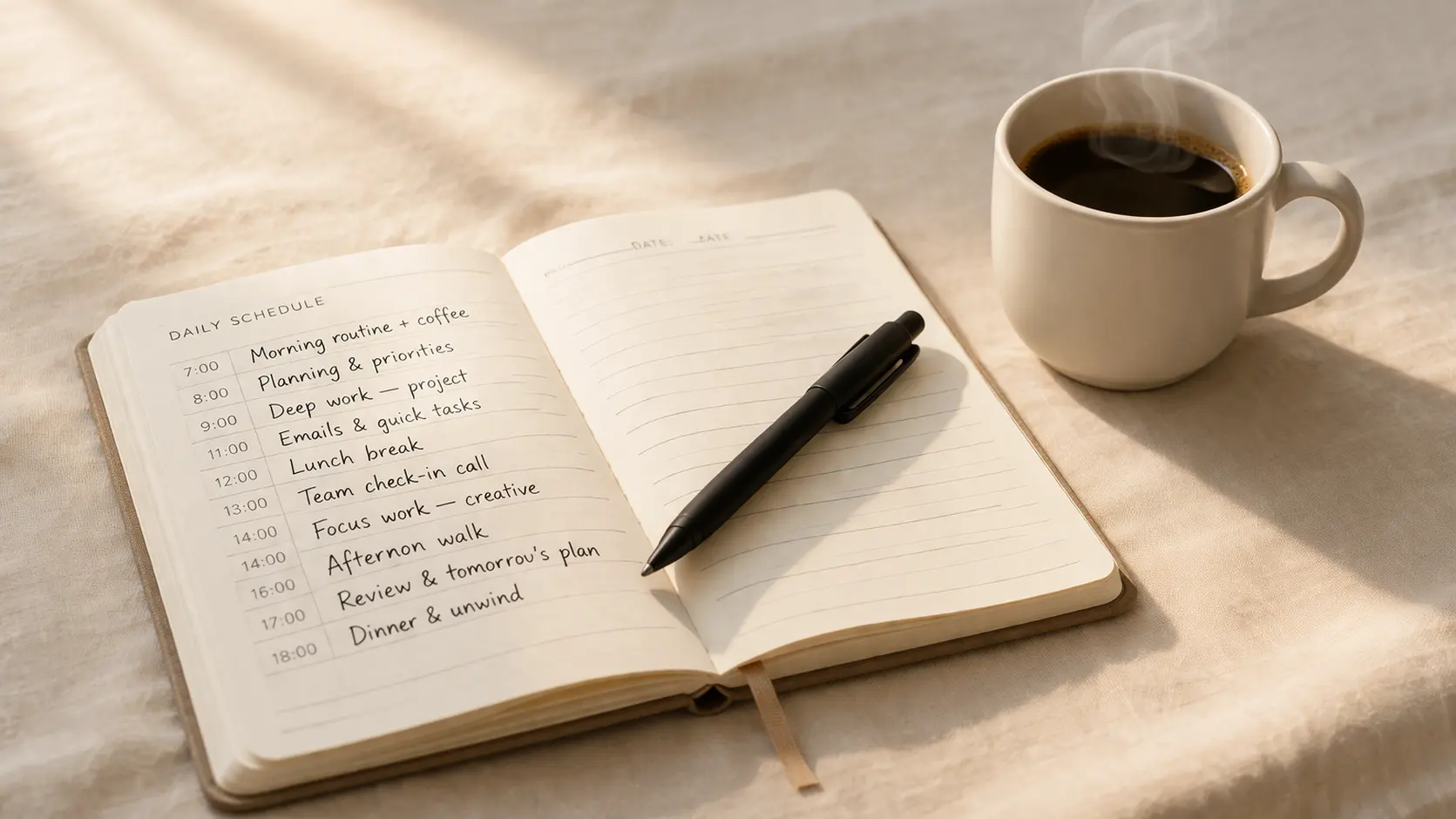
Most people don’t have a time management problem. They have a planning problem.
If you’ve ever reached the end of a workday, wondering where the hours went despite starting with a full to-do list and the best intentions, you already know this. Learning how to plan your day effectively isn’t about squeezing more tasks in. It’s about understanding why the way most of us structure our days works against us, and building a system that actually fits how your brain operates.
These seven strategies aren’t the usual “wake up at 5am and journal” advice. They’re counterintuitive, research-backed, and built for real working days full of meetings, interruptions, and tasks you’d rather avoid. Let’s get into it.
Why Most People Struggle to Plan Their Day Effectively.
The average knowledge worker switches between tasks more than 300 times a day. And according to research from the University of California, Irvine, it takes an average of 23 minutes to fully refocus after an interruption.
Do the arithmetic. If you’re interrupted just five times before noon, you’ve effectively lost nearly two hours of productive capacity before lunch.
The problem isn’t your discipline. It’s that most planning systems are designed for ideal days, not real ones. They assume long uninterrupted stretches, consistent energy levels, and tasks that behave predictably.
Here’s what actually works instead.
7 Strategies to Plan Your Day Effectively.
1. Design Around Constraints, Not Availability.
Here’s something counterintuitive: the less time you give yourself to complete a task, the more focused you become.
Parkinson’s Law states that work expands to fill the time available for its completion. Give yourself all day to write a report and it takes all day. Give yourself two hours? Your brain shifts gear. You cut the non-essential, make decisions faster, and stop waiting for conditions to feel perfect.
Try this: before you plan what you’ll do tomorrow, plan what you won’t do. Block lunch, a walk, and finish time. Treat these as fixed appointments. Then plan your work around what’s left. You’ll find your priorities become sharper the moment time feels finite rather than abundant.
2. Use the Two-List Method for Daily Planning.
Most planning systems tell you to capture everything in one place. That’s actually terrible advice.
When “reply to James about the proposal” sits next to “launch the new content strategy,” your brain treats them as equally urgent. Nothing gets proper attention. Everything gets partial attention.
A better approach: keep two lists. One labelled Today, one labelled Someday. Your Today list gets a maximum of three substantial items not thirty. Three. These are the tasks that, if completed, would make the day feel worthwhile.
Everything else goes on someday. And here’s the crucial part: give yourself full permission to ignore the Someday list until your three Today items are done. This isn’t doing less, it’s doing what matters with your full attention rather than spreading thin across a list that never shrinks.
If unclear priorities are making it hard to build your Today list, our guide on how to prioritise your tasks at work gives you a clear framework for deciding what actually belongs at the top.
How to Prioritize Tasks at Work: The Essential 3-Layer System for Professionals.
3. Batch Similar Tasks to Protect Deep Work
Every time you switch from writing a report to answering a Slack message to reviewing a document, your brain pays a context-switching tax. That 23-minute refocus cost compounds quickly.
The fix isn’t perfect, but uninterrupted silence is unrealistic for most working days. It’s batching: grouping similar tasks so you minimise how many times your brain has to change gears.
Think of it the way a professional chef preps ingredients. They don’t chop one onion, cook it, then chop the carrots. All the chopping happens together, then all the cooking. Same principle applies to knowledge work.
A practical starting point: designate 9–11am for deep work only. Block 11am–12pm for all communication email, Slack, calls. Use 2–4pm for meetings. The exact schedule matters less than the principle. Group like with like, and protect the groupings.
4. Match Your Tasks to Your Energy, Not the Clock.
Not all hours are equal. Your 9am brain and your 3pm brain are genuinely different cognitive instruments.
Most people waste their sharpest hours on email, admin, and routine check-ins then try to do complex, creative work in the afternoon when mental capacity is running low. The result feels like working hard without getting anywhere.
Spend a week mapping your energy honestly. When do complex problems feel solvable? When does writing flow? When do routine tasks feel manageable rather than painful? Once you know your pattern, protect your peak hours for your hardest, highest-value work.
Save email, scheduling, and anything that doesn’t require deep thinking for the low-energy windows. This single shift matching task type to energy level often has more impact than any productivity app or system. Our guide on staying focused at work goes deeper on how to protect these peak windows from interruption.
5. Stop Mid-Flow Intentionally
Most productivity advice tells you to push through until a task is complete. Here’s a better approach: stop while things are going well.
This sounds counterproductive, but it’s rooted in solid psychology. The Zeigarnik effect describes how our brains continue processing incomplete tasks subconsciously. When you stop mid-flow knowing exactly what comes next and leave yourself a one-line note about the next step your brain keeps working on it quietly while you’re away.
The result? You sit down the next day with far less startup friction. Instead of staring at a blank page trying to remember where you left off, you pick up exactly where you stopped.
Ernest Hemingway used this technique in his writing. He’d stop mid-sentence when the words were flowing well, making it easier to begin the following morning again. It works equally well for reports, proposals, and any complex project that spans multiple sessions.
6. Procrastinate Strategically on the Right Tasks.
This might be the most counterintuitive strategy: not everything on your list deserves immediate attention. In fact, deliberately delaying the right tasks can actually make you more productive overall.
The key is distinguishing between destructive procrastination, avoiding important work, and strategic procrastination, intentionally delaying tasks that are low-stakes, likely to resolve themselves, or not yet ripe for action.
Try waiting 24 hours before responding to non-urgent emails. Delay minor decisions until the last responsible moment you’ll often find they become irrelevant. Let meeting requests sit before accepting; half of them either resolve or become unnecessary.
This isn’t about being disorganised. It’s about recognising that your attention is your most valuable resource, and not every task has earned it yet. If you’re struggling with the darker side of procrastination the kind that stalls important work our guide on how to stop procrastinating at work covers exactly how to break that cycle.
7. Build a Weekly Preview Into How You Plan Your Day.
The most effective daily planners don’t just plan their days in isolation. They zoom out once a week to see the bigger picture then plan their days from that vantage point.
Spend 20–30 minutes every Sunday evening doing a simple weekly preview. Not detailed hour-by-hour scheduling that’s a recipe for frustration when reality diverges from the plan. Just identify the 3–5 outcomes that would make the week successful.
Then look for the obstacles. Which days are meeting-heavy? When do you have uninterrupted blocks? What deadlines are approaching? This preview stops you from hitting Thursday and realising Friday’s presentation isn’t ready.
The weekly preview also lets you make strategic decisions upfront batching all your meetings on Tuesday and Thursday, keeping Monday and Wednesday clear for deep work, front-loading the hardest tasks when your energy is fresh at the start of the week.
Your Daily Planning Checklist.
Use this as a quick reference when setting up your day:
When
What to do
Sunday evening
Night before
First 90 minutes
Mid-morning
Afternoon
End of day
Weekly preview: identify 3–5 outcomes for the week, spot obstacles.
Write your Today list with a maximum of 3 substantial items.
Deep work blocks the hardest, highest-value task only.
Communication batch email, Slack, calls all at once.
Meetings, admin, routine tasks, low-energy window.
Stop mid-flow if in deep work, write tomorrow’s Today list
Frequently Asked Questions: How to Plan Your Day Effectively.
What is the best way to plan your day effectively?
Start the night before, not in the morning. Write a maximum of three priority tasks for the next day in your Today list. When you sit down to work, your first decision is already made. Combine this with time blocking protecting your peak energy hours for deep work, and you have a daily planning system that holds up even on difficult days.
How long should daily planning take?
Five minutes the night before is enough for most people. Write your three priorities, glance at your calendar for the next day, and leave yourself a note on where to pick up any open projects. The weekly preview on Sunday takes 20–30 minutes. Beyond that, over-planning becomes its own form of procrastination.
Should I use a planner app or a paper notebook?
Use whichever one you’ll actually open every single day. The medium matters far less than the consistency. Paper planners work well for people who find screens distracting. Apps work well if your work lives on your devices anyway. The goal is a daily planning habit, not the perfect tool.
Why does my daily plan always fall apart?
Usually one of two reasons. Either the plan is too ambitious, with more than three substantial tasks, or it is optimistic for most real workdays. Or it’s too rigid a plan that can’t absorb a 30-minute interruption, it’s not a plan, it’s a wish list. Build in buffer time, limit your Today list to three items, and treat interruptions as normal rather than failures.
How do I plan my day when I have back-to-back meetings?
Batch your meetings into one or two days per week if your role allows it. If it doesn’t, identify any natural 25–30 minute gaps and protect them for your one most important task of the day. Even a single focused block in a meeting-heavy day is better than nothing and it keeps the habit alive.
The Planning System You’ll Actually Use.
The best way to plan your day effectively isn’t the most sophisticated system. It’s the one you’ll use tomorrow, and the day after, and the week after that.
Your productive morning routine sets the tone, your Today list gives you direction, and your energy map tells you when to do what. Put those three things together, and your daily schedule stops being something that happens to you and starts being something you design.
Start with one strategy from this guide. Just one. Use it for two weeks before adding another. What genuinely moves things forward will quickly become obvious.
Which strategy are you going to try first? Drop it in the comments and if this guide helped you build a better daily structure, share it with someone on your team who could use a cleaner system.
Want practical productivity strategies every week? Subscribe to the Daily Insights newsletter and get ideas like these delivered straight to your inbox.