
How relaxing/ laughing helps to reduce stress is something millions of people need to learn, long after the Covid-19 episode. Imagine this: Your alarm clock goes off, and even before your feet touch the floor, you’re already thinking about everything there is to be done that day. Sound familiar? You’re not alone. There is a legion of people waking up as if they are behind already, still struggling with yesterday’s stress starting all over in the morning.
But I also have fantastic news for you: you don’t need costly regimens or hours in therapy to feel better. The answer to managing stress may be simpler than you think, and it starts with two things you already do every day: breathing and laughing. Knowing how relaxing/ laughing helps to reduce stress can turn them from nearest into dearest, taking control back of your day.
Stress In our run along society, stress is as much a built-in as the morning’s first coffee. But for most of us, we never learned the simple tools that can help turn our nervous system from panic mode to peace mode in mere minutes. Today, we’re diving into the science of why laughter really is the best medicine and how mixing it up with intentional breath can help build you a stress-busting toolkit that you can use anywhere, anytime.
Why Stress Keeps Us on Edge
When the stress comes, your body can’t tell if it’s an approaching deadline or a charging Tiger. Your sort-of survival system goes into overdrive, inundating your bloodstream with stress hormones such as cortisol and adrenaline. Your heart rate soars, your muscles contract and your mind goes on red alert ready to fight or flee.
These stress responses served our ancestors well in the face of actual, physical threats. But nowadays, it fires up for everything from traffic jams to text messages, putting us in a nearly permanent state of high alert. The problem? Your body was not built to be that tense all day long. That’s precisely why learning how relaxing/ laughing helps to reduce stress is essential.
The flip side of this stress response is what scientists call the relaxation response your body’s self-healing counteraction to stress an inborn capacity to downshift biochemically and your nervous system, allowing for biochemical equilibrium and a sense of well-being. Consider it a reset button for your nervous system. When you bring about this response through methods such as deep breathing or real laughter, you’re literally rewiring your body’s response to stress.
The beauty is this system is more under your control more than you realize. You can’t always get rid of stressors, but you can learn to see them in a more balanced way. This is exactly why understanding how relaxing/ laughing helps to reduce stress becomes so crucial for modern living.
The Science Behind How Relaxing/ Laughing Helps to Reduce Stress
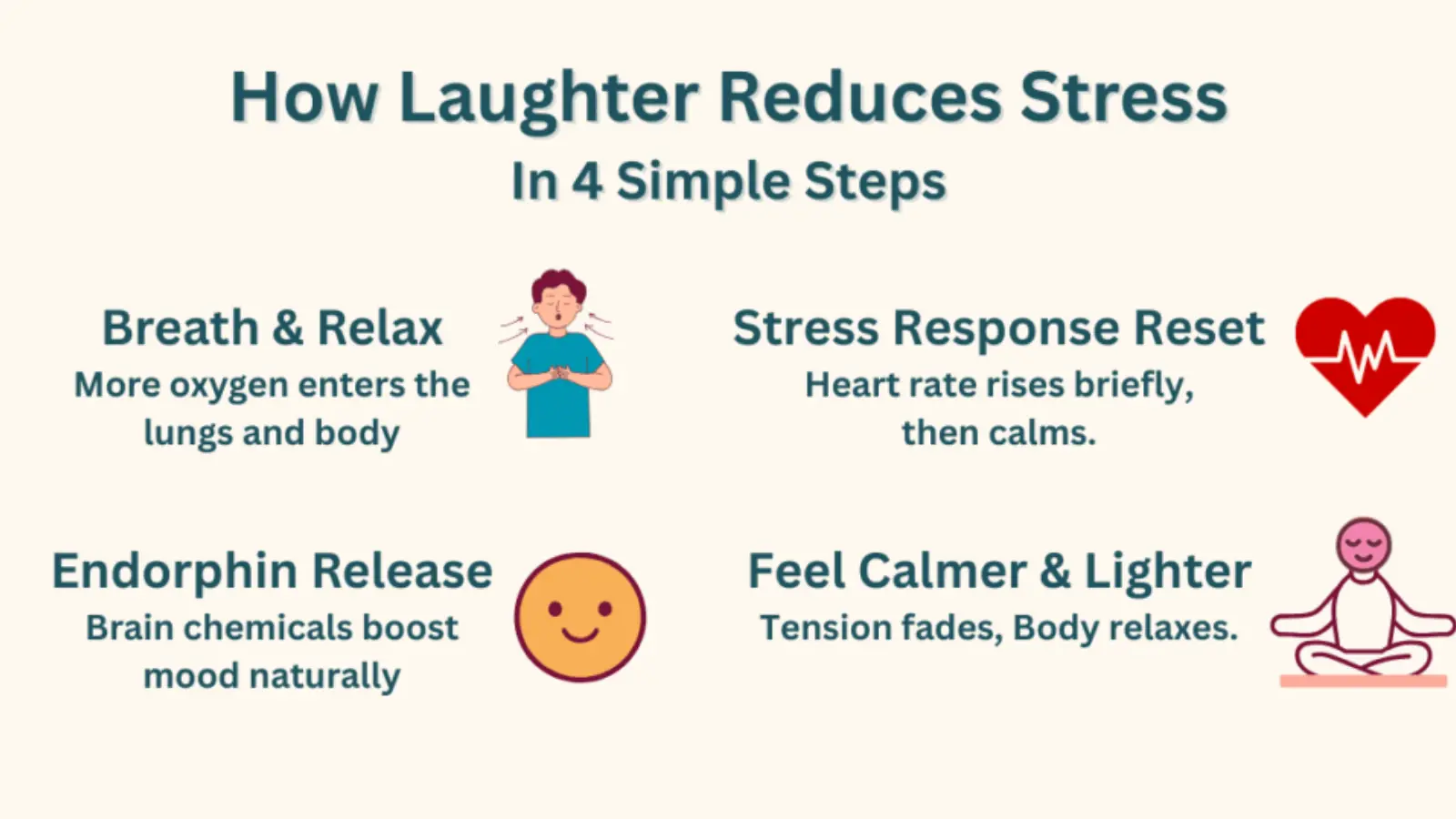
Have you ever experienced how a good laugh can change your mood in an instant? There’s science to support this feel-good phenomenon. Laugh for real, and your brain produces a combination of feel-good chemicals (endorphins, our natural “happy drugs” being among them).
At the same time, you understand in very telegraphed terms how relaxation/ laughing makes stress “disappear” as you watch cortisol levels plummet on screen instantaneously. Research: A good guffaw can lower your cortisol levels by as much as 50% within a couple of minutes. It’s like a built-in prescription stress-relief that costs nothing and comes with no side effects.
The scientific advantages of laughter for stress relief benefit more than just feeling good at the moment. Regular laughter literally rewires your brain to help you better handle future stresses. It’s as if you are constructing emotional muscle to enable you to rebound more quickly from the curveballs life inevitably throws.
Laughter and Immune System Strength
This is another powerful example of how relaxing/ laughing helps to reduce stress. Here’s a twist: laughing and immune system boost are linked. When you burble, you’re not just perking up, you’re physically beefing up your body’s defenses.
Laughter raises production of antibodies and activates immune cells including T-cells, capable of attacking virus-infected cells; and natural killer cells, which can attack infected fighter cells. This is your body’s first layer of defense in response to illness and disease. In other words, you work out your immune system a little bit every time you chuckle.
In one study from Loma Linda University, people who watched a funny video had improved immune function over those who did not. The relationship between positive emotions and physical health is so well-established that some hospitals offer “laughter therapy” to help patients recover.
Relaxation as a Natural Stress Reliever
How Relaxation Techniques Reduce Stress Naturally
Understanding how relaxing/ laughing helps to reduce stress means recognizing, the relaxation is not merely collapsing onto the couch after work (though that has its place, too). Legit relaxation techniques do this by firing up your parasympathetic nervous system, the branch that governs your “rest and digest” processes.
Abdominal breathing is probably the simplest relaxation technique. When you slow your breaths, intentionally, you send a direct signal to your brain that it’s safe to chill out. Your heart rate slows, blood pressure falls and those stress hormones begin to recede.
Another strong technique is that of progressive muscles relaxation. When you systematically tighten and then release different muscle groups, your body learns the difference between tension and relaxation. It’s akin to teaching your muscles to relax when told.
Even meditation for just 5-10 minutes each day can rewire your brain’s response to stress. Long-term mediators also appear to develop additional gray matter in sections of the brain relating to emotional regulation and less activity in the amygdala your brain’s “alarm” center.
Happiness Through Humor and Calmness.
And think of relaxation as resetting your body’s stress thermostat. Just as you would modify the temperature in your home, you also have a measure of conscious control over reducing your stress level through such intentional practices. This perfectly demonstrates how relaxing/ laughing helps to reduce stress on a physiological level.
When you’re taking both ways to manage stress in one, it’s like a two-pronged assault on your tension. Laughter offers immediate relief and fresh perspective, while techniques for relaxation help to extend that calmer state over the long term. Together, they act as a buffer against daily stress that so many of us experience.
The key is self-compassion. A lot of people feel guilty about allowing or seeking out laughter, and silly for doing so. But looking after yourself is not self-indulgent; it’s essential to maintain good mental and physical health.
7 Powerful Breathing and Laughter Exercises You Can Try Today
Exercises For Managing Stress With Breathing & Laughter.
Ready to take this science for a test drive? Some easy breathing and laughter exercises to help you understand the effect of relaxing and laughing on stress, that demonstrate exactly how relaxing/ laughing helps to reduce stress in real-time.
The 4-7-8 Stress-Busting Breath (Two minutes)
- Take a deep breath through your nose counting to 4
- Hold your breath for 7 counts
- Purse your lips and breathe out through the mouth, counting to eight.
- Repeat 4 times
It works because the extended exhale activates your relaxation response faster than ordinary breathing does.
Morning Laughter Yoga Starter
- Begin with forced laughter: Loudly repeating “Ha-ha-ha” for 30 seconds
- Don’t be concerned if it feels a bit silly: That’s part of the point!
- Frequently, the laughter is contagious
- Either way, your body receives the same amazing rewards
The Ultimate Stress-Reset Combo
- Practice one round of 4-7-8 breathing
- Follow that up with 30 seconds of fake laughter
- Finish with one last deep breath.
- Total time: under 3 minutes
Box Breathing for Instant Calm
- Breathe in for 4 counts
- Hold for 4 counts
- Exhale for 4 counts
- Hold empty for 4 counts
- Repeat 6 times
Belly Laugh Breathing
- Put one hand on chest and one on belly
- Do deep breathes that make your belly hand rise more than chest hand
- Include soft “ho-ho-ho” sounds with the exhalation
- Continue for 2-3 minutes
The 3-2-1 Giggle Break
- Think of 3 funny memories
- Tell someone near you 2 jokes
- Breathe in for a minute, deeply and slowly.
- Perfect for midday stress relief
Evening Wind-Down Combo
- Begin with 5 deep breaths in and out.
- Watch or remember something that brings a smile to your face
- Finish with some gentle breath as you keep that smile.
- Ideal before sleep
Quick Practices for Daily Use
Here are some easy ways to wind down and laugh the stress away: Lazy way, active way. Whatever your schedule allows, these simple techniques to ease anxiety can be incorporated into your busy calendar.
- Morning giggles: Find a funny meme or video to watch with your coffee ( improves mood for hours)
- Traffic therapy: Listen to something funny on your commute (it makes annoying drives enjoyable)
- Breathing breaks: Schedule three deep breaths per hour (reduces workday angst)
- Laughing lunch: Swap funny tales with your co-workers (building connectedness and relieving stress in one).
- Elevator exercise: Fast 4 count breaths in elevators (dead time used)
- Breathing at bedtime: Train breaths in as you go to sleep, (helps rest quality)
- Weekend warrior: Put some laughs into your outdoor activities for more gain
The Ultimate Guide to Long-Term Stress Management Benefits
How Laughter Therapy and Relaxation Techniques Transform Your Life
These methods are powerful not singly, but in combination. Regular practice reshapes your brain’s structure and function, so you are naturally more able to withstand stress. This is the true essence of how relaxing/ laughing helps to reduce stress over the long term. Those who regularly use natural stress reducers (laughter, breathing, relaxation) experience:
- Better sleep quality
- Better relationships (it’s easier to deal with other people when you’re not chronically stressed)
- Enhanced creativity and problem-solving abilities
- More emotional strength when we are going through rough patches
- Less anxiety and depression
Success story: Mark, a software developer who began spending 5 minutes each day doing breathing exercises and viewing comedy clips after suffering chronic work stress. Six months later, his blood pressure was normal, he slept better and his team observed that he was more collaborative and creative during meetings. What began as stress-management techniques are now tools for life enhancement across the board. This is the true essence of how relaxing/ laughing helps to reduce stress over the long term.
Putting It All Together
The wonderful thing about using laughing, letting go and breathing exercises is that they all feed each other. Now that you’ve learned how relaxing/ laughing helps to reduce stress, you can see that laughter opens your heart and mind, allowing you to relax down even more. Breathing will relax your nervous system and allow real joy and humor to emerge.. Relaxation is the fertilizer in which they both will grow.
You do not need to be proficient in all of these concepts all at once. When you practice regularly, you’ll discover firsthand how relaxing/ laughing helps to reduce stress in your daily life. Begin with what comes most naturally, it might be tapping on funny videos, or you could connect better to deep breathing. It’s all about that consistency not perfection.
“Raising children is unavoidably stressful, but suffering from chronic stress isn’t. You have more control over your stress response than you believe, and the tools to access that control are in fact no further away than your next breath or laugh. When you practice regularly, you’ll discover firsthand how relaxing/ laughing helps to reduce stress in your daily life.
Conclusion
Stress management doesn’t have to be another daunting chore that gets added to your already brimming plate. When you understand how relaxation/ laughing works to release stress, the relief is just a few moments away anytime you need it. There’s nothing to buy or obtain, even though it’s completely free, its advantageous power may come as a surprise.
On those days when things seem dark at work, when the family stress gets to be too much or your mind is just spinning and you don’t know how to switch it off, you now have seven scientifically proven tools that will help shift your state quickly and naturally.
Thanks to: Intentional breath, real laughter, and relaxation techniques that are more than just about feeling better in the moment, it’s also about creating a stronger, more resilient version of yourself over time and reclaiming your calm and joy.
Small, consistent changes and granting yourself the permission to put your well-being first. Your stressed-out self will thank you, and everyone in your life will love the more relaxed, happy version of you who emerges. Always remember that all experts were once a beginner your path to stress-free living begins today with one deep breath and one sincere smile.
Related: How to Break Free of Food Obsessions
And stress doesn’t just affect our breathing and mood it can also, for some people, lead to unhealthy relationships with food. When you’re stressed, or anxious and overwhelmed, most people find they spend a lot of time thinking about food. And if you’ve ever found that stress leads to an unhealthy obsession with meals, snacks or eating habits, you’re hardly alone.
Ready to transform your stress response? Try one of these 7 techniques today and share your favorite in the comments below. Which breathing exercise worked best for you? Let’s build a community of stress-free living together.