


Your energy doesn’t actually run out; it runs on a rhythm. If you’ve ever wondered how to manage your energy levels throughout the day, you’re not alone, and the answer isn’t more coffee or an earlier alarm.
If you’ve ever started the day sharp, hit a wall by 2pm, and spent the rest of the afternoon pushing through fog, that’s not a willpower problem. That’s a structural problem. And the structure can be fixed.
Most people never learn how to manage energy levels throughout the day because nobody teaches it as a system. This guide breaks down a time-based framework built around how your body and brain actually work using proven energy management tips that fit into a real day, not a perfect one.
Why Your Energy Crashes and It’s Not What You Think.
Most people blame the crash on bad sleep, too much caffeine, or not eating right. Those things matter. But the deeper reason is something most productivity advice completely ignores: your body runs in natural energy cycles, and most daily schedules are built as if it doesn’t.
Your brain moves through what researchers call ultradian rhythms, roughly 90-minute cycles of high alertness followed by a dip. Studies published by the National Institutes of Health confirm these cycles exist across both sleep and waking hours. When the dip hits, your body is asking for a short recovery window.
Most people respond by reaching for coffee and pushing through.
That’s where the problem compounds. Caffeine delays the signal; it doesn’t erase it. The energy debt builds up across the day, and by mid-afternoon, you’re running on fumes and stimulants, not actual energy.
Understanding this rhythm is the first real step to managing your energy instead of just surviving the day.toward managing your energy rather than
The 4-Block Daily Energy Framework.
Instead of treating energy as a flat resource you either have or don’t, think of your day in four time blocks. Each block has a different energy profile and a different strategy.
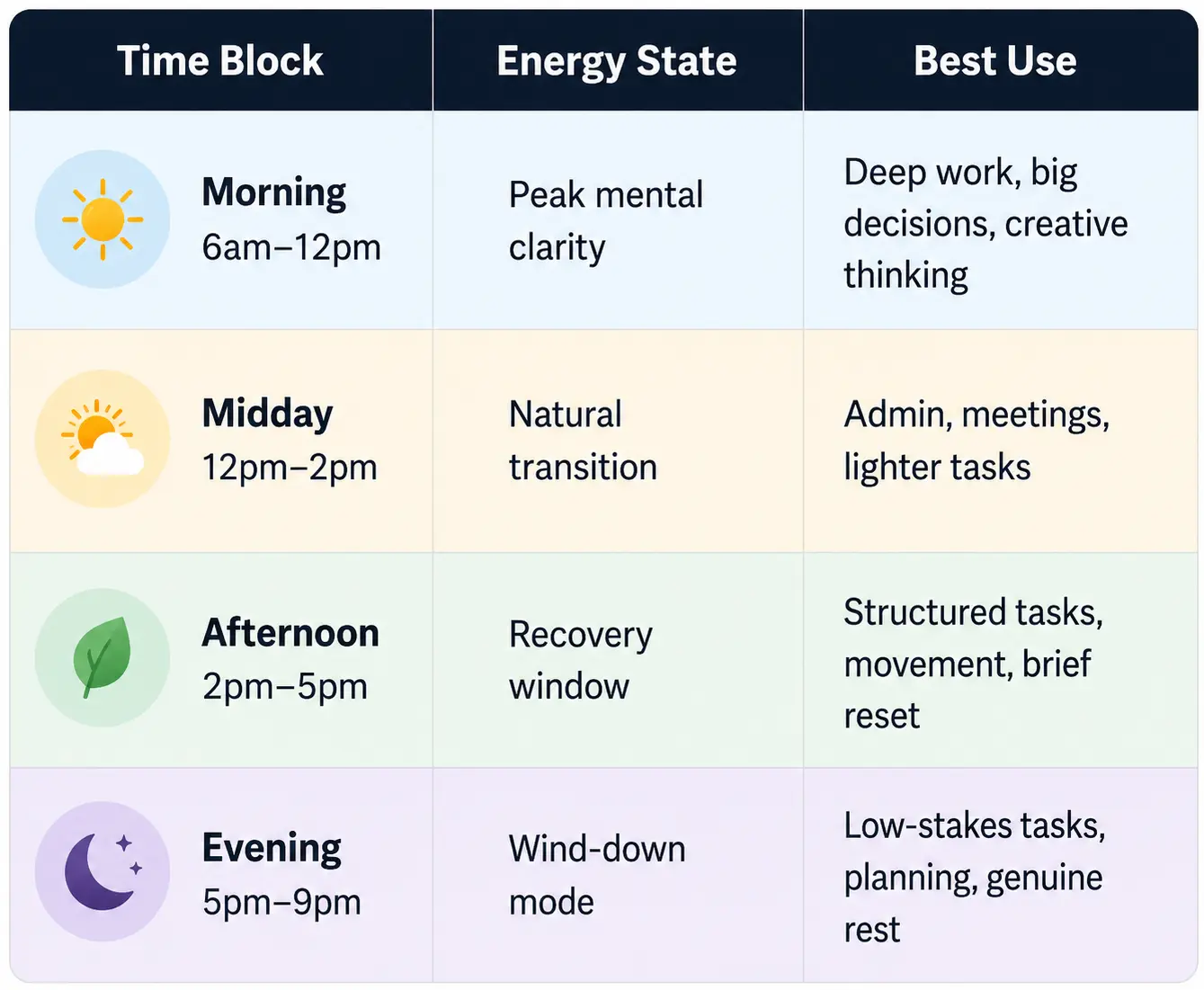
This is the core structure for how to manage your energy levels throughout the day, and it works because it aligns with biology, not willpower.
Morning (6 am–12 pm): Protect Your Peak.
The first 90 minutes after waking are your highest-value window. Cortisol is naturally elevated, mental clarity is at its sharpest, and your brain’s capacity for complex thinking peaks here.
Most people burn this window on emails, social media, and low-stakes tasks. That’s an expensive mistake.
What to do instead:
- Start your morning routine before opening anything reactive no inbox, no phone
- Identify your one hardest task the night before and go straight to it
- Delay caffeine by 60–90 minutes after waking; your natural cortisol spike handles alertness early, and spacing coffee out extends its effectiveness through mid-morning.
Your morning energy is your single most valuable daily asset. Guard it deliberately.
Productive Morning Routine: 4 Proven Steps That Actually Work.
Midday (12pm–2pm) Sustain Without Crashing.
This window is a natural transition point. Energy is shifting down from its morning peak. This is not the time to schedule demanding cognitive work it’s the time to use the energy you still have without burning reserves you’ll need later.
What works here:
- Eat a protein-forward lunch heavy carbohydrates at midday are the fastest way to trigger an afternoon crash
- Take a short walk after eating; even 10 minutes improves afternoon alertness significantly, according to research from the Sleep Foundation.
- Use this window for meetings, calls, and collaborative tasks. Social interaction is naturally energising during this period.
Avoid treating midday as an extension of your morning focus window. You’ll overspend energy you don’t have yet.
Why Does My Energy Crash in the Afternoon?
This is one of the most searched questions about daily energy and the answer isn’t simply “you didn’t sleep enough.”
The afternoon dip, typically between 2pm and 4pm, is biologically programmed. It corresponds to a dip in core body temperature and a natural low point in your ultradian cycle. Even people who sleep perfectly well experience it.
The crash feels worse when you:
- Ate a high-carbohydrate lunch.
- Didn’t move at any point in the morning.
- Pushed through a previous energy dip without resting.
- Front-loaded too much caffeine and crashed off it.
The fix isn’t more coffee. The fix is a structured afternoon reset which the next section covers directly.
Afternoon (2pm–5pm) Recover and Refocus.
This is the most mismanaged part of most people’s days. Instead of working with the dip, most people fight it and lose two to three hours of real output as a result.
The 20-minute afternoon reset:
- Stop: at the first real sign of the dip glazed focus, re-reading the same sentence, restless scrolling
- Move: a 10–15 minute walk outside is the most effective single reset tool available
- Rest briefly: a 10–20 minute nap (no longer) restores alertness without sleep inertia
- Return:with one clearly defined task not open-ended thinking work
After a proper reset, most people find a genuine second wind between 3:30pm and 5pm. That’s not willpower; that’s biology working correctly.
If focus during this window is a consistent struggle, the strategies inside How to Stay Focused at Work apply directly here.
Getting this block right is often the biggest single improvement people notice when they start managing their energy levels throughout the day intentionally.
5 Energy Management Tips That Keep Your Levels Consistent.
Beyond the time blocks, these five habits form the foundation of natural ways to boost energy without relying on stimulants. Skip any one of them regularly and the whole framework becomes unstable.
1. Anchor your sleep and wake times.
Your circadian rhythm is set by consistency, not duration alone. Waking at the same time every day, including weekends, stabilises your energy patterns faster than almost any other single habit.
2. Hydrate before you caffeinate.
Mild dehydration causes fatigue, reduced concentration, and increased effort perception. Drink 400–500ml of water before your first coffee. It takes 60 seconds and produces a measurable difference in morning alertness.
3. Move before noon.
Exercise in the morning front-loads your energy dividend for the entire day. You don’t need an hour at the gym. Twenty minutes of walking or bodyweight movement is enough to increase alertness and improve mood regulation across the full day.
4. Eat for energy, not just hunger.
Highly processed foods and refined carbohydrates create blood sugar spikes followed by crashes. A meal built around protein, healthy fats, and fibre digests more slowly and produces a flatter, more stable energy curve.
5. End work with a hard stop.
Energy recovery occurs during genuine rest, not during half-rest while still mentally at work. A defined end to your workday is not a luxury. It’s a biological requirement for sustained performance. If switching off is something you actively struggle with, How to Stop Thinking About Work After Hours addresses this directly.
How to Stop Thinking About Work After Hours: 4 Proven Steps to Finally Switch Off.
How to Manage Mental Energy The Part Most People Miss.
Here’s what most energy advice overlooks entirely: mental energy and physical energy are not the same thing, and they don’t recover the same way.
You can sit at a desk all day doing nothing physically demanding and end up more exhausted than someone who spent the day on their feet. Why?
Because decision fatigue, constant context-switching, and low-grade background anxiety are extraordinarily expensive in cognitive energy terms. Every unresolved task in your head, every unnecessary micro-decision, every interruption mid-deep-work carries a cost even when you can’t feel each individual charge.
This is why learning to manage mental energy is just as critical as sleep and nutrition when you’re trying to sustain energy at work across a full day.
Practical ways to protect your cognitive load:
- Reduce daily decisions where possible batch choices, use defaults, automate recurring tasks.
- Single-task deliberately context-switching reduces effective cognitive performance by up to 40% in the moment.
- Keep a capture system for stray thoughts a simple notepad or app so your brain isn’t holding open loops all day.
Evening (5pm–9pm) Wind Down With Purpose.
Evening isn’t wasted energy time. It’s tomorrow’s energy being built right now.
Your sleep quality and therefore your next-day energy is directly shaped by what you do in the two hours before bed. Blue light exposure, late eating, unresolved mental loops, and screen stimulation all suppress melatonin and reduce the quality of deep sleep you get.
Evening energy management in practice:
- Dim screens or use blue light filtering from 8pm onwards.
- Avoid heavy meals within 2–3 hours of sleep.
- Do a brief brain dump or next-day planning session offloading open loops onto paper reduces overnight cortisol and improves sleep onset speed.
- Keep a consistent wind-down signal a short walk, a few pages of reading, or a simple routine that tells your nervous system the day is genuinely done.
Sleep is the single highest-leverage energy recovery tool available. No supplement, no morning hack, and no optimisation routine compensates for consistently poor sleep.
How to Manage Your Energy Levels Throughout the Day: Build Your Routine.
Every person’s energy rhythm is slightly different. The framework above gives you the map your job is to personalise the route.
Start here:
- Track your energy for 3 days: note your alertness level every 2 hours on a 1–10 scale. Clear patterns emerge quickly.
- Identify your peak window: this becomes your non-negotiable deep work time.
- Build one anchor habit per block: one intentional action in the morning, midday, afternoon, and evening.
- Protect before you optimise: stop spending peak energy on low-value tasks before adding anything new to your day.
You don’t need a perfect daily energy routine. You need a consistent one. That consistency is what managing your energy levels throughout the day actually looks like in practice, not perfect, just deliberate
Frequently Asked Questions.
Does managing your energy levels throughout the day really make a difference to productivity?
Yes, and the difference is significant. Most productivity problems are actually energy problems in disguise. When you align your hardest work with your peak energy windows and protect your recovery periods, you get more done in less time without burning out. It’s not about working longer. It’s about working at the right times.
How long does it take to see results from an energy management routine?
Most people notice a difference within 3 to 5 days of anchoring their sleep and wake times consistently. The afternoon crash typically reduces within one to two weeks once the midday habits are in place. Full rhythm stabilisation where your energy feels genuinely predictable usually takes three to four weeks.
Is the afternoon energy crash normal or a sign something is wrong?
It’s completely normal. The 2pm–4pm dip is a biological feature, not a flaw. It corresponds to a natural drop in core body temperature and a low point in your ultradian cycle. The goal isn’t to eliminate it it’s to work with it by scheduling low-demand tasks during that window and using a short reset to come back stronger.
Can I manage my energy levels without changing my diet completely?
Absolutely. Diet helps, but it’s not the starting point. The highest-leverage changes are sleep consistency, delaying caffeine by 60–90 minutes after waking, and protecting your peak morning window from reactive tasks. These three alone produce noticeable results before you change a single meal.
What is the biggest mistake people make when trying to manage energy at work?
Treating all hours as equal. Most people schedule their day based on deadlines and calendar availability not energy availability. They spend peak energy on emails and meetings, then try to do deep creative work during their lowest window. Reversing this one habit alone changes everything.
Final Thought.
Knowing how to manage your energy levels throughout the day isn’t about doing more.
The people who seem to have unlimited energy aren’t working harder. They’re working smarter with their biology.
Start with one block. Pick the one where you lose the most time right now and apply one strategy from this guide this week. One change, consistently applied, will show you more results than a perfect plan sitting in a notebook.
Which part of the day drains you the most the morning start, the afternoon crash, or winding down in the evening? Share it in the comments below.
