


Most mornings do not fail because you woke up too late. They fail because you woke up with no plan for what to protect.
You sit down, open your laptop, check Slack out of habit, respond to two things that did not need responding to, glance at your calendar, feel vaguely anxious about the day, and then spend the next hour in a low-grade reactive mode. By the time you feel ready to do real work, half the morning is gone. Sound familiar?
This is not a discipline problem. It is a design problem. A productive morning routine is not about waking up at 5am or journaling for thirty minutes before sunrise. It is about creating a short, repeatable structure that protects the first hours of your day from the forces that fragment it.
I have seen this pattern consistently across professionals at every level. The people who struggle most with mornings are rarely the disorganised ones. They are the conscientious ones who care about doing good work and have no system to protect the time when that work actually happens.
This guide covers what that structure looks like, why most morning routine advice fails working professionals, and how to build a version that fits your actual life, not someone else’s highlight reel.
Why Most Morning Routine Advice Does Not Work.
The morning routine content you find online falls into two camps. The first is the 5am miracle crowd cold showers, hour-long meditation, journaling, exercise, and a green smoothie before most people’s alarms go off. The second is the vague productivity list drink water, avoid your phone, set intentions. Neither is useful.
The 5am approach fails because it is built around an identity shift, not a system. It asks you to become a different kind of person before it gives you any results. For someone managing a real workload, a demanding schedule, and limited control over their environment, that is not a starting point. It is a fantasy.
The vague list fails for the opposite reason. Telling someone to avoid their phone without giving them a specific alternative is like telling someone to stop eating sugar without explaining what to eat instead. The behavior you want to stop fills a function. Until you replace that function with something deliberate, the old habit wins every time. Both approaches share the same flaw: they focus on what to add to your morning rather than what to protect it from. That distinction is everything
A productive morning routine works not because it adds more to your morning, but because it removes the decisions and defaults that drain your focus before the day has properly started
What actually works is a structure that is short enough to be realistic, specific enough to be actionable, and stable enough to become automatic. That is what this guide builds.
What Your Morning Is Actually Competing Against.
Before building a routine, it helps to understand what you are designing against. Your morning attention is being competed for by several forces simultaneously most of them invisible until you name them. Once you name them, the framework below will make immediate sense.
Notification pull
Studies on smartphone behavior consistently show that most people check their phones within the first few minutes of waking. That first check does not just consume time, it sets the cognitive tone for the entire morning. You have handed your first mental energy of the day to whoever messaged you last night.
Whatever was in that notification a work problem, a news headline, a social media update is now the frame through which you enter your day. Reactive before you have had a single intentional thought. Most people do not notice this is happening because they have done it every morning for years.
Decision fatigue before 9am.
Every small decision you make in the morning what to wear, what to eat, what to work on first, whether to answer that email now or later draws from the same cognitive budget you need for real work.
Research published by the American Medical Association on decision fatigue confirms that this resource is finite and depletes earlier than most people realize. By the time you sit down to do something that genuinely matters, you have already spent a meaningful portion of your best thinking on decisions that did not require it.
The absence of a first task.
Most professionals start their morning by checking what other people need from them email, Slack, and messages. This feels productive because it involves activity. A busy inbox feels like progress.
It is not. Your first hour has been spent on other people’s priorities rather than your own. The day rarely recovers from this fully. You spend the rest of it playing catch-up on the things that actually matter to your own work, always one step behind where you intended to be.
The Productive Morning Routine Framework.
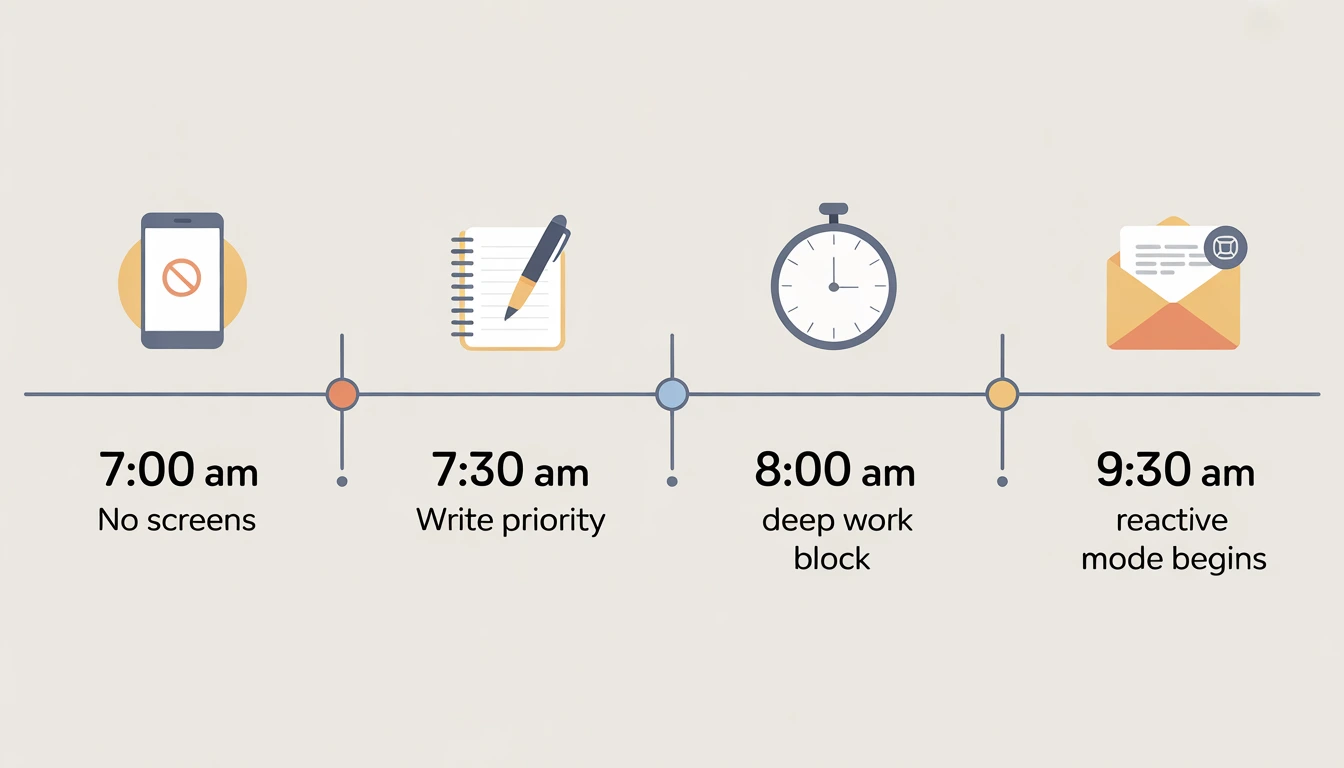
The framework below takes between 30 and 60 minutes, depending on your situation. It has four components and in my experience, most people only need the first two to feel a noticeable difference within a week. The third and fourth deepen the system once the first two feel automatic. These are the morning habits for professionals that actually hold up when life gets complicated.
1. A hard boundary before screens.
Step one sounds almost too simple. Do not check your phone, email, or any notifications for the first 20 to 30 minutes after waking. Not to be trendy. Not because screens are evil. Because those first minutes are the only time in your day when your attention belongs entirely to you before the world has made any claims on it. Most people skip this step. Those same people spend the rest of the morning feeling like they are already behind.
Use that window for something that costs nothing cognitively make coffee, shower, sit with your thoughts, or go for a short walk. The goal is to arrive at your desk with your attention intact rather than already parceled out.
If this feels impossible because of genuine responsibilities a child who needs attention, a partner, a commute make the boundary smaller. Ten minutes works. Five minutes works. The length matters less than the consistency. Try it tomorrow before you decide it will not work for you.
2. A single written priority.
Before opening any communication tool, write down one thing. Not a to-do list. One sentence describing the single most important piece of work you need to move forward today.
This takes ninety seconds. What it does is force a moment of judgment before reactive mode begins. You have decided what matters before the day tells you what is urgent. The distinction between important and urgent is where most professional output is lost, and this single step protects against it every morning.
Think of a project manager juggling four client accounts. Their inbox every morning is full of things that feel urgent, status requests, scheduling threads, and quick questions that need answers. Their actual work, the proposal that moves the project forward, the brief that only they can write, sits untouched until 3 pm when their energy is at its lowest. One sentence on a piece of paper, written the night before, changes that entire sequence.
The question is not: what do I need to get done today? The question is: what is the one thing that, if I move it forward this morning, makes everything else easier or less necessary?
Write it on paper. Not in your task manager, not in Notion, not in a pinned Slack message. Paper creates a physical commitment that a screen cannot replicate. It also means you see it every time you glance up from your work. This connects directly to how to prioritize tasks at work the decision is made before the day’s noise begins, not in the middle of it.
How to Prioritize Tasks at Work, The Essential 3-Layer System for Professionals.
3. A protected first work block.
After writing your priority, go directly to it. Not to email. Not to Slack. Not to your task manager to reorganize your week. Directly to the work itself.
Block sixty to ninety minutes. Close every tab that is not related to that one task. Put your phone face down or in another room. Set your status to focused work until a specific time and then do not touch it until that time arrives. If staying focused at work is something you struggle with, this first block is where that system matters most.
Read our this blog: How to Stay Focused at Work: 4 Fixes for the Root Cause.
This block does not need to be perfect. You will get distracted at some point. That is not failure, it is Tuesday. The measure of success is whether you return to the work without guilt and without ceremony. Notice you drifted, close the distraction, come back. That is the entire skill. It gets easier faster than you expect.
4. A clean transition into the reactive day.
After your first work block ends, you open communication tools and enter the part of the day that belongs to everyone else. Emails, Slack, meetings. This is not the enemy it is a necessary part of most professional roles.
What changes is the feeling you bring to it. You are entering the reactive part of your day having already done something that matters. The inbox no longer feels like a threat because the work that actually counts has already moved forward. That shift from reactive to proactive is what a well-built morning routine for productivity actually provides. It is quieter than most people expect. And more durable.
The other bookend matters just as much. A strong morning starts the night before, which means protecting your evening from the same reactive patterns. If work thoughts follow you home and disrupt your recovery, How to Stop Thinking About Work After Hours covers the shutdown routine that closes that loop.
How to Stop Thinking About Work After Hours: 4 Proven Steps to Finally Switch Off.
How Long Should a Morning Routine Actually Be.
The honest answer is: as long as it needs to be and no longer.
The productivity industry has a bias toward elaborate systems because elaborate systems are easier to sell. A morning routine that takes four steps and thirty minutes does not feel transformative enough to put on a book cover. But it works, which is the only thing that matters.
For most knowledge workers, the realistic window is thirty to sixty minutes. If you have children, a long commute, or other genuine constraints, the window might be fifteen minutes. That is enough. A fifteen-minute routine executed every single day is worth more than a ninety-minute routine attempted twice a week.
Start smaller than feels necessary. Sustainable beats optimal every time. A routine you can do on your worst Monday, tired, behind, and already stressed, is the only routine worth building.
Common Mistakes That Kill a Productive Morning Routine.
Making it too complicated on day one.
The most common reason morning routines collapse is attempting a full overhaul simultaneously. New wake time, new exercise habit, new journaling practice, new phone rules all at once. Within two weeks the cognitive weight of maintaining everything breaks down, and the old defaults return as if nothing changed.
Pick one component from the framework above. Do it for two weeks. Add the next component only when the first feels automatic. This is slower than you want and faster than starting over every month.
Optimizing the routine instead of doing the work.
There is a version of morning routine culture that has quietly become its own form of procrastination. Researching the perfect journaling method. Buying the right notebook. Adjusting your wake time by fifteen minutes to find the optimal window. Testing three different alarm apps.
None of this is the work. The work is sitting down and doing the thing you wrote on your piece of paper. If you notice you are spending more time refining the routine than following it, that is the signal to stop refining and start doing.
Treating a disrupted morning as a failed day.
Some mornings will not go to plan. You will oversleep. Your child will be sick. An urgent message will arrive that genuinely cannot wait. One disrupted morning is not a broken routine it is a normal Tuesday in a normal career.
The professionals with the most consistent morning routines are not the ones who never miss. They are the ones who return to the structure the next day without drama or self-criticism. Miss a morning. Come back tomorrow. That is the whole recovery strategy.
Adapting This Productive Morning Routine for Remote Work and Flexible Schedules.
Remote workers and freelancers face a specific version of this problem that office workers do not. Without a commute or a physical office to travel to, the boundary between personal time and work time dissolves entirely. The productive morning routine becomes more important, not less, because it is doing structural work that a physical environment used to do automatically.
If you work from home, the screen-free window and the transition into your first work block matter more than they do for anyone else. Something that signals to your brain that work mode has begun a specific coffee, a particular desk, a specific playlist is not a luxury. It is the psychological boundary that a commute used to provide for free. You are building that boundary yourself.
For freelancers managing multiple clients, the single written priority becomes genuinely critical. Without a manager or team structure organizing your work, the pull toward reactive client communication in the morning is especially strong. Every client feels like an equal priority until you decide otherwise. The piece of paper with one priority on it is what separates your agenda from theirs.
The Point Is Not the Routine.
A productive morning routine is not the goal. It is the infrastructure that makes the goal possible.
The goal is to do work that matters. To make progress on things that are genuinely important to your career and your life. To end more days feeling like you moved forward rather than just stayed afloat.
The routine is how you protect the conditions for that. It keeps your best attention for your own priorities before the day claims it. It eliminates the small decisions that drain your cognitive resources before you sit down to work. It creates a repeatable structure that your brain can follow without friction, even on the mornings when everything else feels hard.
You do not need to wake up at 5am. You do not need a cold shower, a gratitude journal, or a green smoothie. You need a boundary before screens, one clear priority written on paper, a protected block of focused work, and a clean transition into the rest of your day.
Build it small. Keep it consistent. Adjust it based on what actually happens in your real life not on what looks good in someone else’s productivity content. The version that works is the version you actually do.
Quick Reference: The 4-Part Productive Morning Routine.
- Hard boundary before screens: 20 to 30 minutes after waking, no notifications, no phone
- Single written priority: one sentence on paper before opening any communication tool
- Protected first work block: 60 to 90 minutes on your one priority before anything else
- Clean transition: enter the reactive part of your day only after your priority has moved forward.
And if you sit down with a clear morning plan but still find yourself stalling before starting that is a procrastination problem, not a routine problem. The guide on how to stop procrastinating at work covers the psychology and the fix.
How to Stop Procrastinating at Work: Why It Happens and 10 Ways to Fix It.
Where Are You Starting?
Most people who read this will agree with it, close the tab, and check their phone the next morning without thinking. Do not be that person.
Pick one component from the framework above and do it tomorrow. Just one. The screen-free window if mornings feel chaotic. The written priority if your days feel unfocused. The protected work block if important work keeps getting pushed to the end of the day.
Which one are you starting with? Drop it in the comments below. Naming it publicly makes it significantly more likely to happen and if you hit a wall with it, ask. That is what the comments are for.
How long should a productive morning routine actually be?
Between 20 and 60 minutes, depending on your schedule and commitments. The length is not what makes it productive the consistency is. A repeatable 20-minute routine you follow every day will outperform an elaborate 90-minute routine you abandon by Thursday. Start with the two highest-impact steps: no screens for the first 20 minutes, and one written priority before you open any communication tool. Add from there once those feel automatic.
What if I am not a morning person?
Your chronobiology is real and worth respecting. A productive morning routine does not require waking at 5 am it requires protecting the first window of your day, whatever time that starts. If your workday begins at 9 am, the routine runs from 9 am. The principle is the same: no reactive input before a clear intention. Forcing yourself into someone else’s schedule creates resistance that makes the routine unsustainable.
What is the single most important thing to do in a morning routine?
Writing one priority before opening an email or Slack. Not a list, one sentence describing the most important piece of work you need to move forward today. This single step protects your first hour from reactive mode and is the foundation on which everything else in this guide is built. If you do nothing else from this article, do that.
Why do most morning routines fail after a few weeks?
Because they are built around addition rather than protection. Most advice tells you to add meditation, journaling, exercise, and cold showers. The routine collapses the moment one element fails. A more durable approach is to protect your morning from the forces that fragment it, notifications, reactive email, unplanned decisions, rather than adding tasks that require perfect conditions to execute.