

There are four things you have on your list. Three individuals have contacted requesting updates. In ninety minutes there is a meeting. And you are sitting at your desk and you have got the same task and you have read it twice without even beginning it.
It is not a matter of time management. You put in the same number of hours as any other person. The real issue is not having a clear system for how to prioritize tasks at work when everything is competing for attention at once.
Most time prioritizing advice says to put tasks in terms of importance and urgency. This can be represented in a two-by-two matrix and then you can go through the quadrants one at a time. It’s not a bad idea. You can only find that useless at the moment you need it, i.e. when you are overwhelmed, and you have not the brains to sort out fourteen various things before you start any one of them.
It is through this article that you will be able to apply a simpler and quicker approach. It is best done on a Tuesday morning when there is too much on your inbox and you do not know what to do first.
Why Prioritization fails When things get tough.
When you have to decide between two or more things when your mind perceives that the situation is a forthcoming threat or danger. The part that controls rational choices and planning, the pre frontal cortex shares resources with the stress response. This implies that the mental ability that you need to prioritize tasks is not working optimally at the time that you will most be in need of it.
This was confirmed by the study done by cognitive scientist Amy Arnsten on the stress and executive functioning. Under acute stress, the brain does not seem to pay attention to deliberate thinking since it redirects resources to reactive processing. You don’t lose intelligence. You become deprived of the ability to weigh competing priorities.
This is why your task list feels overwhelming instead of clarifying when you are already under pressure. The list is not the problem. It is the mental state in which you are reading it. A system for prioritizing your work is not something you can build mid-crisis it is something you design in advance, so that when stress hits, the decision is already made.
The other trap that causes failure in prioritization is the trap of urgency. The immediate tasks, those that have someone waiting, a deadline to be met today, a reminder with it, seem important since it is loud and it is present. The critical projects, the ones that may be considered essential to push your career, projects, and goals forward, are usually silent jobs that operate in the background. They don’t pursue you. They sit and are always relegated as you waste your time in doing things that appear urgent yet do not necessitate the actual skill to be accomplished.
A workday centered around responding to the demands of the moment ends with the inbox clear and the important work left unfinished. The pattern continues over months and weeks into a career that feels full but doesn’t progress. If context switching is behind the problem, read this article: How to Stay Focused at Work, to learn how to stay focused at work before applying this system.
The Three-Layer System for How to Prioritize Tasks at Work.
Layer 1: Your One Non-Negotiable.
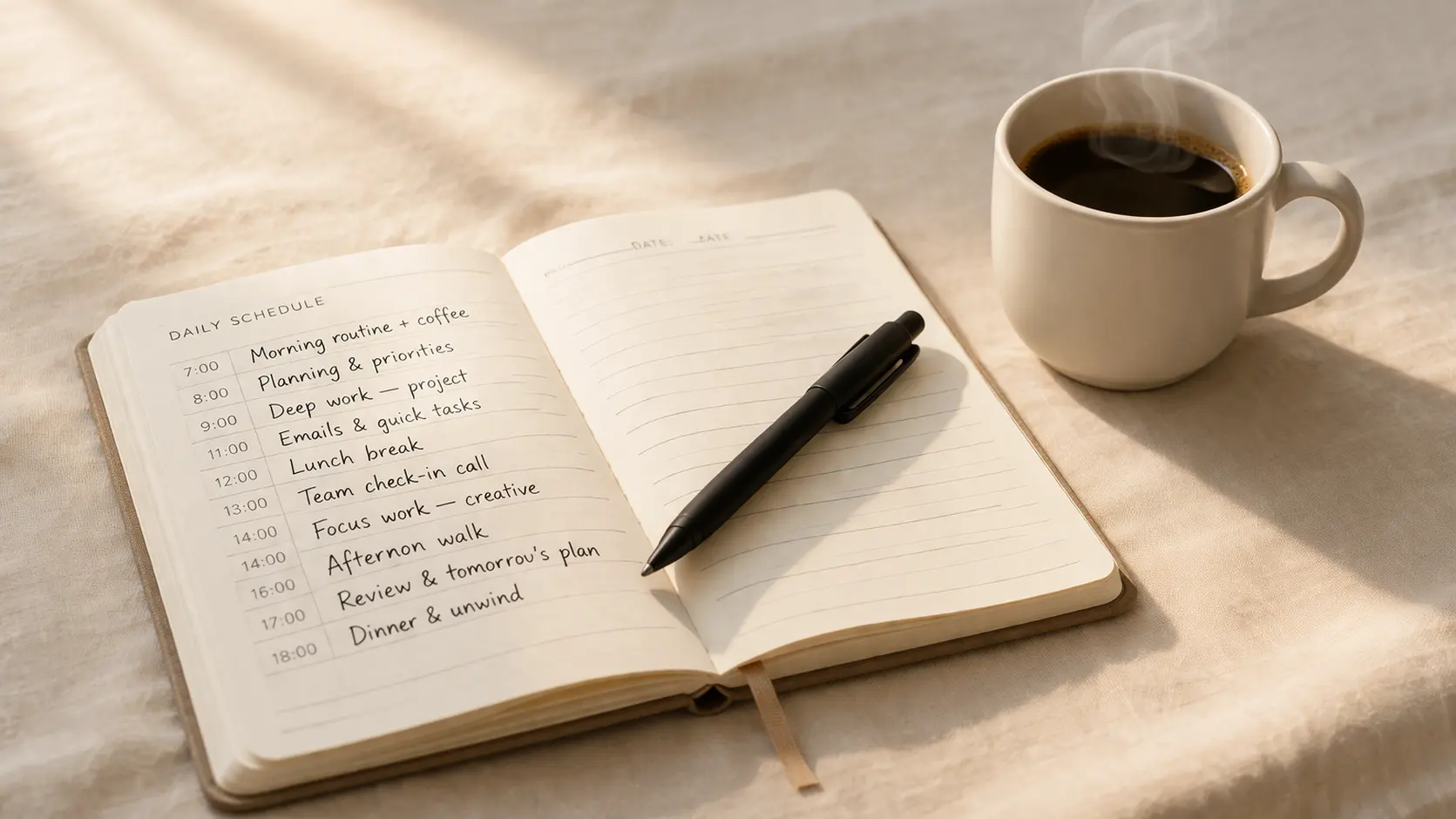
This is your non-negotiable. It is the thing that, when done will leave the day an achievement no matter what occurs otherwise. Draw it up in a writing. Not in your task manager. Not in a pinned note. The reason paper is better than a screen is in the fact that, with writing a commitment that a screen cannot reproduce, and the fact that you will see it every time you look up out of your work.
The non-negotiable is controlled by too much; it must be a piece of work you create and not a response you make. It is not a must to reply to emails. The completion of a first draft of a report is. Updating a client is not. It is making them complete their analysis.
Such a difference is important since responsive work will grow to whatever amount of time you invest in it. The work that you need to do is productive and to do it, you must consciously save up time. That protection starts with knowing how to prioritize tasks at work before your inbox tells you what to do.
Layer 2: Rank Your Responses by Actual Cost.
Most of the messages can be categorized into three. The first one is really time- based: one cannot go on with their work until you report, a decision must be made before a dead line is coming or a client has an emergency. These are a response to your deep work block.
The second will happen but not immediately, a regular update request, a question that might have to be answered today but not in the next one hour, or a thread that you have been copied on and it needs your response. These enter your day time communication time.
The third one is all other: FYI messages, newsletters, stuff that you were put on an unnecessary thread, requests that will not be sent until tomorrow. You do not give these a thought to-day. Most practitioners have discovered that when they are sincere when using this filter, less than one out of five morning messages are in the former category.
The rush they had opening the inbox was rather imagined, not actual. That gap between perceived and real urgency is the core of how to prioritize tasks at work without burning out your decision-making by 9 am.
Layer 3: Sequencing, Not Importance
Be mindful of your own tendencies. When you are most awake and when you usually get into a lull. Attempt to keep a record of your energy over a couple of days, by noting down the time of day when you seem most at ease and at other times you feel most challenged by difficult work. A basic three column log is: Time, Energy Level (1-5), and Task. Few entries daily will indicate the trend within a week.
Thought-processing and imaginative work – writing, problem solving, strategizing, anything that needs long-term focus, should be in the morning when cognitive energy is the most active. Administerial and attentive tasks, such as updating trackers, arranging schedules, regular emails, status reports, etc. should be put in the afternoon when the energy levels are inherently low. Team activity such as meetings and feedback may be placed in either slot based on your calendar.
This sequencing implies that you will be doing your most difficult work when your brain can best do it, and your least difficult when you only have to do less of it. There is increased output even though the addition of hours is non-existent. That is the third layer of how to prioritize tasks at work and the one most people skip entirely.
How To Deal with an Emergency During the Mid-Day.
Any system crashes when one walks to your desk or writes a message regarding something that really cannot be deferred. It occurs within all workplaces, and no prioritization model will avoid it completely.
It is not about the way to prevent interruptions. It is how to cope with them and not miss the thread of what you are really doing. In cases where something comes urgently, put a two-minute appraisal before taking action. Ask three questions. Is this something that I have to play a role in or can it be done by another person? Will it have to take place within an hour or within this day? What is the real cost when it takes two hours to wait?
In the majority of the cases, sincere replies will show that it is significant to the person who poses the question but not really urgent to you. Note down, assure the sender that you will come back to it by a certain time and get back to whatever you were doing.
Two expressions that can be used without any friction:
“To a manager: I’d like to give this the attention it deserves can I come back to you when I wrap up what I’m working on at 11?”
“To a peer: I’m just finishing something up I’ll take a look after lunch and get back to you by 2.”
Among the best professional skills that you can acquire is the ability to differentiate between the urgency of another person and your priorities. It is moreover one of the least taught.
In cases of where something actually requires immediate attention, e.g. a production problem, a client crisis, a real deadline conflict, etc. then do it, and resume your system. A single interruption does not nullify the structure. Start where you have left.
The Most Common Mistake When Learning How to Prioritize Tasks at Work.
The most common mistake with prioritization is treating the task manager as the only source of truth. Task manager is an inventory, not a strategy. The task manager records what exists, not what matters. When you log into your task manager first thing and begin working from the top, you are letting the sequence of task creation determine your priorities. That order was set by whoever created each task, at whatever time they created it, for whatever reason felt important then. It has no connection to what actually matters in your work right now.
The solution is not a change of tools, but a change of habits. Your task manager is a tool, not a starting point. You look at it when you have checked your non-negotiables – to locate the work, to put it into context, to know the deadlines. You do not open it to determine what to work on. You decide that after you open nothing.
Using This System when You Lead the Work of Other People.
The lack of clarity about priorities at the beginning of the day is the cause of most of the coordination overhead of junior teams. When people demand updates, it is not due to the fact that they are not organized but because they do not know what is the most important thing and do not want to make sure that they are working on the wrong one.
The same approach to how to prioritize tasks at work applies here, just made visible to the team. This does not need a stand-up or a project management tool. It demands one simple answer to the question: what is the one thing we absolutely must go forward with today? When that is explicit, even this informal, in a short message, then it provides everyone with a point of reference with which to base decision-making all through the day without returning to you each time something new comes up.
Building How to Prioritize Tasks at Work Into Your Morning.
The best place to apply this system for how to prioritize tasks at work is not in the middle of a chaotic Tuesday. It is the night before, or first thing in the morning, before the demands start arriving. It’s the night before, or at the start of your morning, before the demands begin arriving.
This is also where your morning structure becomes critical. Writing your non-negotiable the night before only works if the morning that follows it is protected free from notifications, reactive email, and other people’s priorities before your own work has had a chance to move. If you have not yet built that structure, the complete system is in Productive Morning Routine: 4 Proven Steps That Actually Work.
Productive Morning Routine: 4 Proven Steps That Actually Work.
At the conclusion of your working day, after five minutes of looking over what is on your list and writing your non-negotiables for the following day, you go to bed the next morning with the most difficult choice already made. You would not need to consider what to begin with. You already know. The paper is there.
Schedule a reminder in your calendar every day or a phone alarm that will go off at the end of your day of work. This outer signal makes the evening review automatic and creates it into your routine with naughty work. This has direct relation to an effective morning routine: when you sit down you go to your non-negotiable not to inbox. The prioritization took place the previous night. It is only execution in the morning.
An Idealistic View of What This Is Like.
Here is what it looks like in practice. Daniel, a content manager at a growing startup, actually learns how to prioritize tasks at work before the day gets away from him. The previous night, he visited the task list and spent four minutes on it, jotting down a sentence on a notepad: complete the first part of the Q3 report.
The non-negotiable of tomorrow.
The following day, Daniel gets down to it, references the note, and opens the file. Before opening Slack or email, he spends sixty minutes on it. During that period, he is unresponsive to any form of communication. Their status displays concentration on work up to 9:30 am.
Daniel checks his inbox at 9.30 and uses the three-category filter. Two messages are time-conscious. He takes less than fifteen minutes to respond to the two. The rest of the messages are sent to the mid-day window. By 10 am, he would have run forward with his most significant work and clear everything that really required an answer.
The remaining day is accompanied by meetings, additional responses, and the administration, but whatever really needed doing was done at the time his brain was the clearest and the day was most silent. Most people who struggle with how to prioritize tasks at work are not missing a better framework.
The Actual Starting Point
Most people who struggle with how to prioritize tasks at work are not missing a better framework. They are also setting the prioritization decision at the inappropriate time, reactively, mid-morning, under pressure, and with everything lying open. Push the decision out to the previous night. Write one sentence on paper. Three layers in the morning. That is the whole thing.
There will still be the to-do list. It will still be long. But you will not be ignore. Most people read this, nod along, and still open their task manager first thing tomorrow morning. Try the opposite. Write your one non-negotiable on paper tonight before you close your laptop and notice what tomorrow morning feels like compared to every other one. Which of the three layers are you starting with? Drop it in the comments below.
Frequently Asked Questions.
How long should a productive morning routine actually be?
As long as it needs to be and no longer. For most working professionals, 30 to 60 minutes is the realistic window. If you have children, a long commute, or other genuine constraints, 15 minutes is enough. A 15-minute routine executed every single day is worth significantly more than a 90-minute routine attempted twice a week. Start smaller than feels necessary, sustainable beats optimal every time.
Do I need to wake up at 5am to have a productive morning routine?
No. Waking up at 5am is not a requirement for a productive morning it is a marketing concept. What matters is not when you wake up but what you do with the first portion of your morning before reactive demands begin. A professional who wakes at 7:30am with a clear structure will consistently outperform one who wakes at 5am and immediately checks their phone.
What is the single most important part of a morning routine for professionals?
Write down one clear priority before opening any communication tool. Not a to-do list, one sentence on paper describing the single most important piece of work that needs to move forward today. This takes 90 seconds and forces a moment of intentional judgment before reactive mode begins. Everything else in the routine supports this one decision.
What should I do if my morning routine gets disrupted?
Return to it the next day without drama or self-criticism. One disrupted morning is not a broken routine it is a normal Tuesday in a normal career. The professionals with the most consistent morning routines are not the ones who never miss. They are the ones who come back the next day without making it mean anything. Miss a morning. Come back tomorrow. That is the complete recovery strategy.
How is a morning routine different for remote workers?
The structure matters more, not less. Office environments provide built-in signals that work has begun, such as a physical desk and colleagues around you. Remote workers lose all of that automatically. The screen-free window and the protected first work block do the structural work that a physical office environment used to provide for free. If you work from home, something that signals work mode has begun a specific desk, a particular routine, or a short walk before sitting down is not optional. It is the psychological boundary you are building for yourself.